
Factory guide
One-Piece Hot-Bent Basin vs Vessel and Undermount Basins: How to Choose
Choose a basin type by weighing seam count, cleaning effort, replacement cost, and faucet and drain fit. A one-piece basin forms the countertop and bowl as one continuous surface, a vessel basin sits above the counter as a separate bowl, and an undermount basin mounts below a countertop cutout. Cleaning tolerance, replacement plans, and existing faucet and drain layouts usually narrow the choice to one type.
By Vora Surfaces Factory Editorial Team · Published 2026-11-01 · Foshan, China
In short: Weigh seam count, cleaning effort, replacement cost, and faucet and drain fit. A one-piece basin gives a continuous counter-to-bowl surface, a vessel basin sits above the counter, and an undermount basin hangs below a cutout.
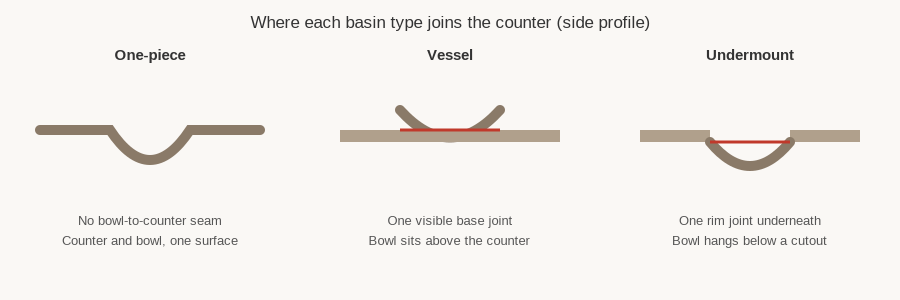
The three basin types at a glance
A one-piece basin joins countertop and bowl into a single unit. Vora’s version is hot-bent in-house from sintered stone, with a seamless basin zone and no glue joints where bowl meets counter. Common widths run 60 to 120 cm, and custom sizes are available.
A vessel basin is a standalone bowl that sits on top of the counter. Its outer wall stays visible, and its base meets the counter along one visible joint line. Swapping one vessel bowl for another of similar footprint is straightforward.
An undermount basin hangs below the countertop around a cutout. From above, you see the cutout edge and bowl interior, while the rim joint sits hidden underneath.
Comparison table: four verifiable dimensions
| Decision factor | One-piece basin | Vessel basin | Undermount basin |
|---|---|---|---|
| Seam count | No bowl-to-counter seam | One visible base joint | One sealed rim joint underneath |
| Cleaning dead spots | One continuous wipe path | Bowl exterior plus counter behind bowl | Hidden rim underside, cutout edge |
| Replacement cost driver | Whole top unit | Bowl alone | Bowl, if cutout matches |
| Faucet and drain fit | Pre-drilled at factory | Needs extra spout height | Counter faucet behind cutout |
Seam count: where each type joins
Seam count drives most of the cleaning difference. A one-piece basin has no seam where bowl meets counter, because the basin zone is formed as one piece. Water and soap film have no joint line to settle into there.
A vessel basin adds one visible joint where the bowl base meets the counter. That joint needs a wipe as part of routine cleaning. An undermount basin has one rim joint too, sealed around the underside of the cutout. The joint stays out of sight; check sealant condition during deeper cleans. See the hot-bent basin range for one-piece models.
Cleaning dead spots: what each type adds to the routine
Cleaning effort follows seam placement. On a one-piece basin, a cloth passes from counter into bowl along one continuous surface, with no rim to scrub around. That single wipe path echoes a common vessel-basin complaint: one owner described having to “clean the inside and the outside of the bowls and contort to clean the counter behind the bowl.”
A vessel basin adds two cleaning zones: the bowl exterior and the strip of counter behind the bowl. An undermount basin keeps the counter clear, and its hidden cost is the rim underside, where the cutout edge can collect residue out of sight. Daily care for all three types follows one routine in our cleaning guide: warm water, mild soap, and a soft cloth.
Replacement cost: what a damaged bowl means
Replacement cost is the honest one-piece trade-off. A damaged bowl zone on a one-piece basin means replacing the top unit, since bowl and countertop form one piece. The cabinet below stays in place, so the job is a top swap, and the cost driver is the full top unit.
A vessel basin reverses that: the bowl alone comes off, the counter stays, and a new bowl of similar footprint goes on. An undermount basin sits between the two: the bowl alone can be replaced, and the replacement has to match the existing cutout and mounting, or the counter needs rework. Field repair is limited for small edge chips; our repair guide covers what field repair can and cannot do. Cracks starting at unsupported cutouts are covered in our guide to why stone tops crack.
Faucet and drain fit: check before you order
Faucet fit separates vessel basins from the other two types. A vessel bowl raises the waterline, so a standard deck-mounted faucet can sit too low to use comfortably. Check spout height and reach against the bowl rim, or plan for a wall-mounted or vessel-height faucet.
One-piece basins arrive with tap holes pre-drilled at the factory, and mainstream mixer tap specs are supported, with hole sizing confirmed with the buyer at order time. Undermount basins take a standard counter-mounted faucet behind the cutout, with cutout-edge clearance as the main check. Drain fit applies to all three types: remodels keep existing plumbing, so drain position has to line up with the pipe below. Our size-mistakes guide lists drain alignment among common contractor-seen errors, and the configurator covers width and layout options.
Honest limitations: what each type cannot do well
No basin type leads on every dimension.
A one-piece basin cannot offer a bowl-only swap. Bowl damage means a top-unit replacement, and bowl shape and depth are fixed at order time, so later style changes mean a new top. The single top unit is bulkier to handle than a separate bowl.
A vessel basin carries the heaviest cleaning load. The bowl exterior and the counter behind the bowl stay on the cleaning list, and a wrong faucet height causes splashing and awkward use. Vessel bowls also use vertical space above the counter.
An undermount basin cannot hide its rim joint from maintenance. The sealed joint underneath needs periodic checks, the cutout edge can collect residue, and a replacement bowl has to match the existing cutout or the counter needs rework. Mounting quality matters, since the bowl hangs from the countertop.
Factory evidence: photos and inspection figures
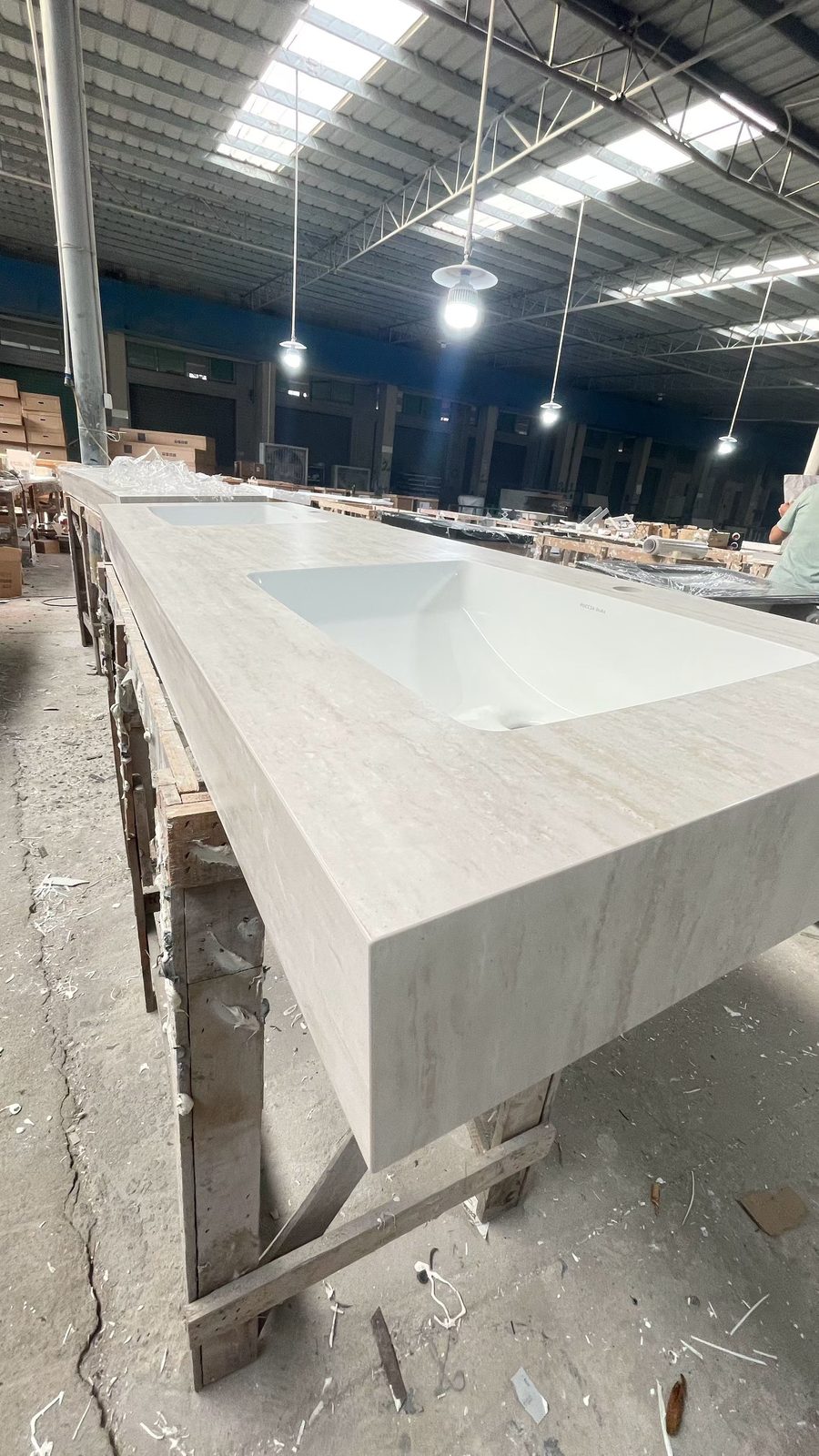
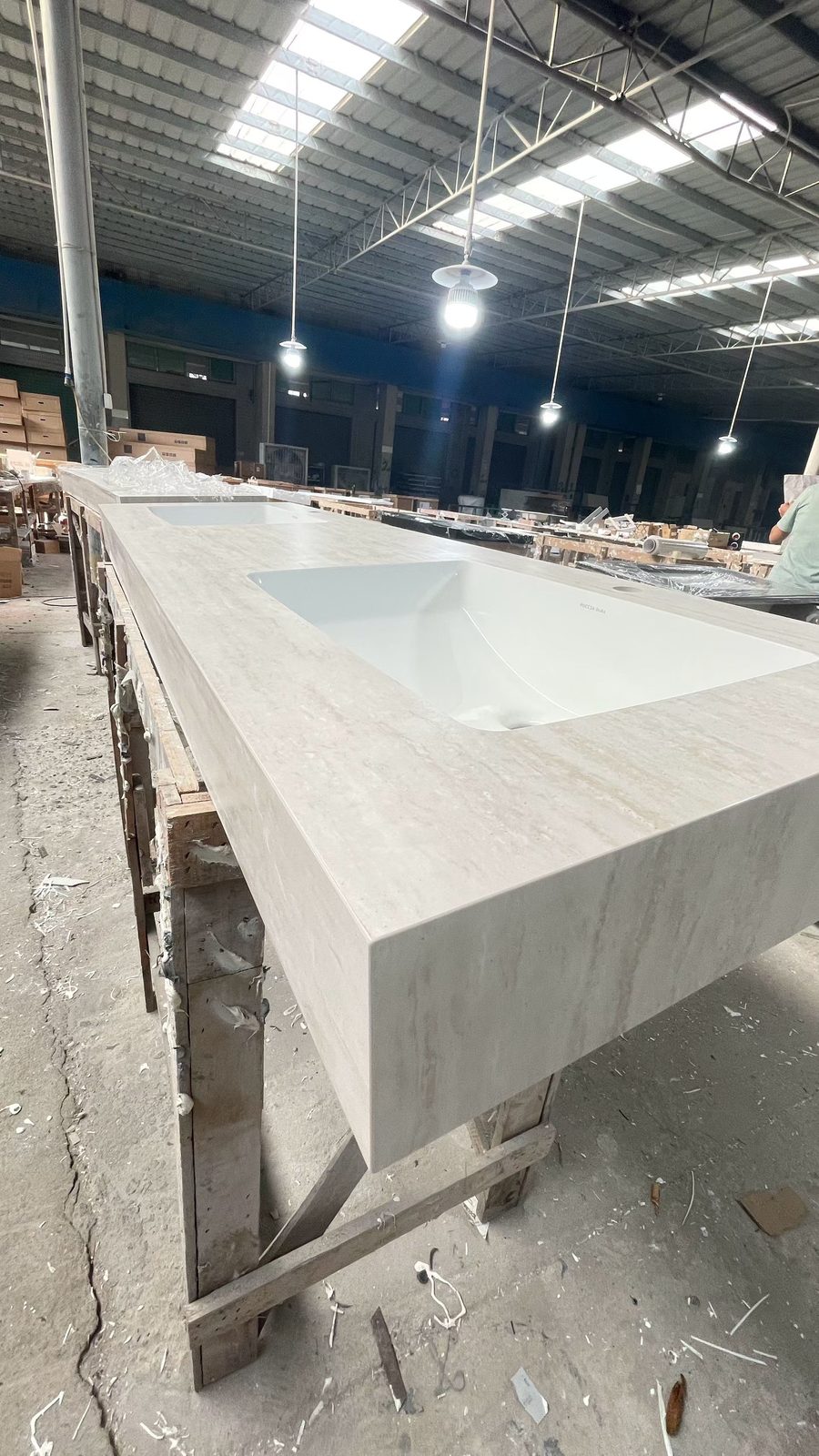
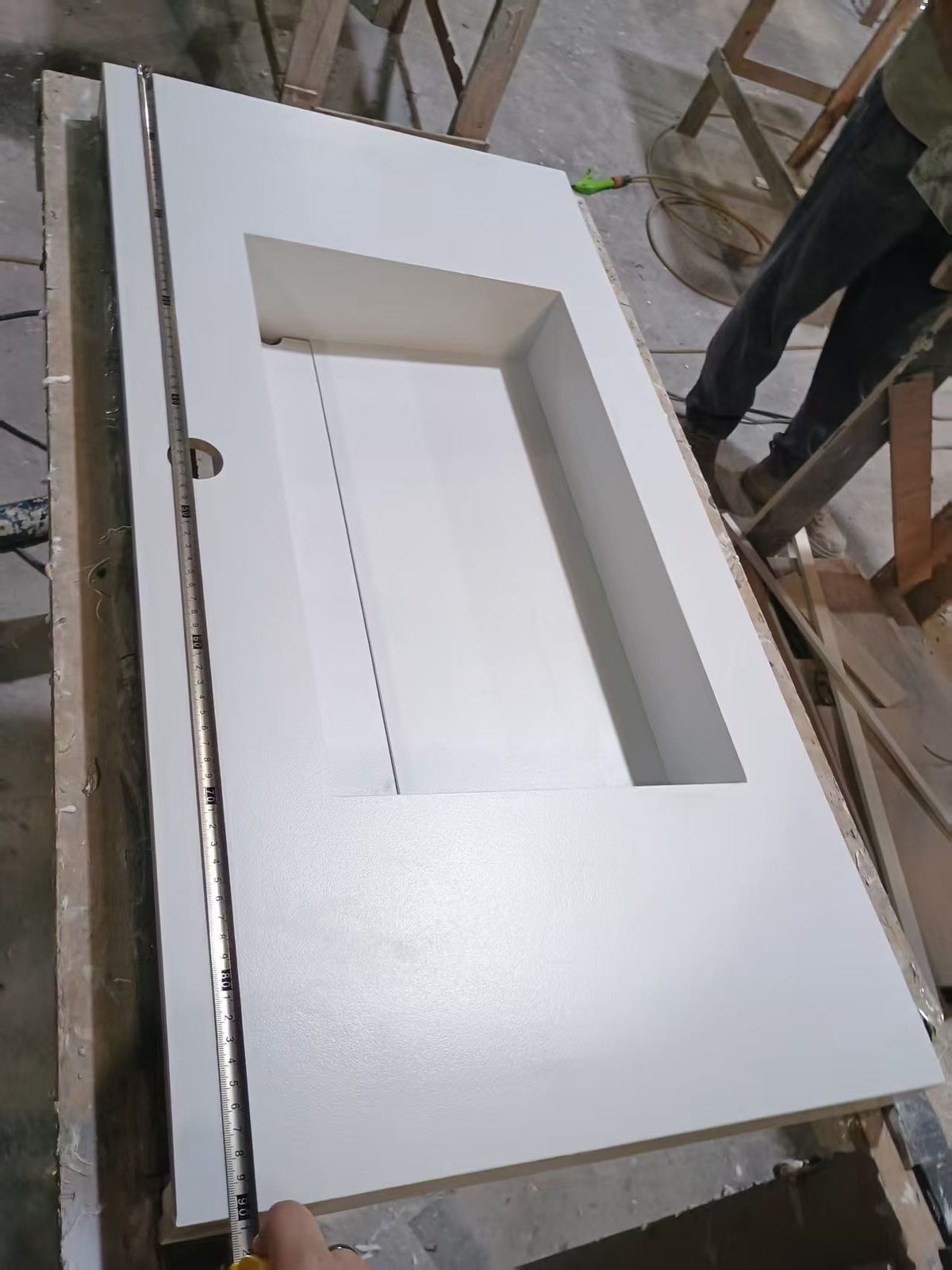
Factory photos show long one-piece vanity tops in production and tape-measure QC checks before packing. Those photos ground this comparison in observed production.
One inspection report adds material context. A 2023 commissioned inspection report (G23-WT10751E, JC/T 2116-2012) recorded water absorption of 0.07% and a 1.1 kN static load with no damage. These figures come from a single-sample commissioned inspection, not product certification, and they describe one tested sample. Low absorption helps explain the cleaning picture: marks stay on the surface. See what a sintered stone basin is for material background.
How to choose: a short decision checklist
- Pick a one-piece basin if you want the fewest seams and the simplest wipe-down, and you accept top-unit replacement if the bowl zone is damaged.
- Pick a vessel basin if you want bowl-only swaps later, or you want to keep an existing counter and change the bowl style.
- Pick an undermount basin if you want a clean counter line with a replaceable bowl, and you accept rim-joint checks as part of upkeep.
- Measure drain position against existing plumbing first, then width, faucet height, and reach. Tap-hole spacing and counter depth complete the checklist.
Frequently asked questions
Is a one-piece basin harder to replace?
Replacing the bowl means replacing the top unit, since bowl and countertop form one piece. The cabinet below stays in place, so the job is a top swap. Buyers who want bowl-only swaps tend to pick a vessel or undermount basin.
Does damage mean the whole top is ruined?
Damage in the bowl zone affects the top unit as a whole, because there is no separate bowl to swap out. Small edge chips have limited field repair options, covered in our repair guide. Deep damage in the bowl area usually calls for a replacement top.
How do seams and cleaning differ among the three types?
A one-piece basin has no seam where bowl meets counter, so one wipe passes from counter into bowl. A vessel basin adds the bowl exterior and the counter behind the bowl to the cleaning routine. An undermount basin hides its rim joint underneath, where the cutout edge can collect residue.
Can I keep my existing faucet and drain with a new basin type?
Check three things before ordering: faucet height and reach, tap-hole sizing, and drain position against existing plumbing. Vessel basins need extra spout height. One-piece basins arrive pre-drilled at the factory, with hole sizing confirmed at order time.
What measurements matter most before I order?
Width, faucet-hole spacing, drain position, and counter depth. Common one-piece widths run 60 to 120 cm. The expensive mistake is a drain landing away from existing plumbing, so measure drain position first, then width.
Ask about a basin type for your project
Send an inquiry with your width, faucet plan, and drain position for basin-type options from the Vora Surfaces factory team. Your inquiry goes to vorasurfaces@gmail.com, and your details are used only to answer this inquiry. Nothing is added to a mass mailing list, and no turnaround time is promised here.
Specifications verified against Vora Surfaces factory records. Editorial review applied. Spotted an error? Email corrections to vorasurfaces@gmail.com.
Frequently asked questions
Is a one-piece basin harder to replace?
Replacing the bowl means replacing the top unit, since bowl and countertop form one piece. The cabinet below stays in place, so the job is a top swap. Buyers who want bowl-only swaps tend to pick a vessel or undermount basin.
Does damage mean the whole top is ruined?
Damage in the bowl zone affects the top unit as a whole, because there is no separate bowl to swap out. Small edge chips have limited field repair options, covered in our repair guide. Deep damage in the bowl area usually calls for a replacement top.
How do seams and cleaning differ among the three types?
A one-piece basin has no seam where bowl meets counter, so one wipe passes from counter into bowl. A vessel basin adds the bowl exterior and the counter behind the bowl to the cleaning routine. An undermount basin hides its rim joint underneath, where the cutout edge can collect residue.
Can I keep my existing faucet and drain with a new basin type?
Check three things before ordering: faucet height and reach, tap-hole sizing, and drain position against existing plumbing. Vessel basins need extra spout height. One-piece basins arrive pre-drilled at the factory, with hole sizing confirmed at order time.
What measurements matter most before I order?
Width, faucet-hole spacing, drain position, and counter depth. Common one-piece widths run 60 to 120 cm. The expensive mistake is a drain landing away from existing plumbing, so measure drain position first, then width.
Sourcing hot-bent basins for your next project?
Send your drawings and target quantities — we'll confirm feasibility from the factory floor.
Configure your inquirySee the products behind these guides: production cabinet styles and buying terms for buyers & OEM.
Specifications verified against Vora Surfaces factory records. Editorial review applied. Spotted an error? Email corrections to vorasurfaces@gmail.com.