
Factory guide
How to Clean a Sintered Stone Basin: What Works and What Damages It
A sintered stone basin cleans with warm water, mild dish soap, and a soft cloth — most marks stay on the non-porous surface, where a cloth can reach them. Skip the harsh end of the cleaning aisle: strong acids and alkalis, scouring pads, and long bleach soaks damage the polish, the metal hardware, and the mirror around it.
By Vora Surfaces Factory Editorial Team · Published 2026-10-13 · Foshan, China
In short: Clean a sintered stone basin with warm water, mild dish soap, and a soft cloth — the non-porous surface keeps most marks on the outside. Diluted vinegar helps with limescale; skip scouring pads, strong acids and alkalis, and long bleach soaks, which dull the polish and attack hardware, mirrors and sealant.
Why cleaning is simple on this material
Stain resistance is baked into the material. Sintered stone’s stain resistance comes from the fused mineral body itself, so there is no coating layer to wear through. Nothing on the surface can peel, craze, or wear off to reveal a weaker layer. That distinction matters for cleaning: whatever lands on the basin — toothpaste, soap, hard-water minerals — stays on the surface, where a cloth can reach it.
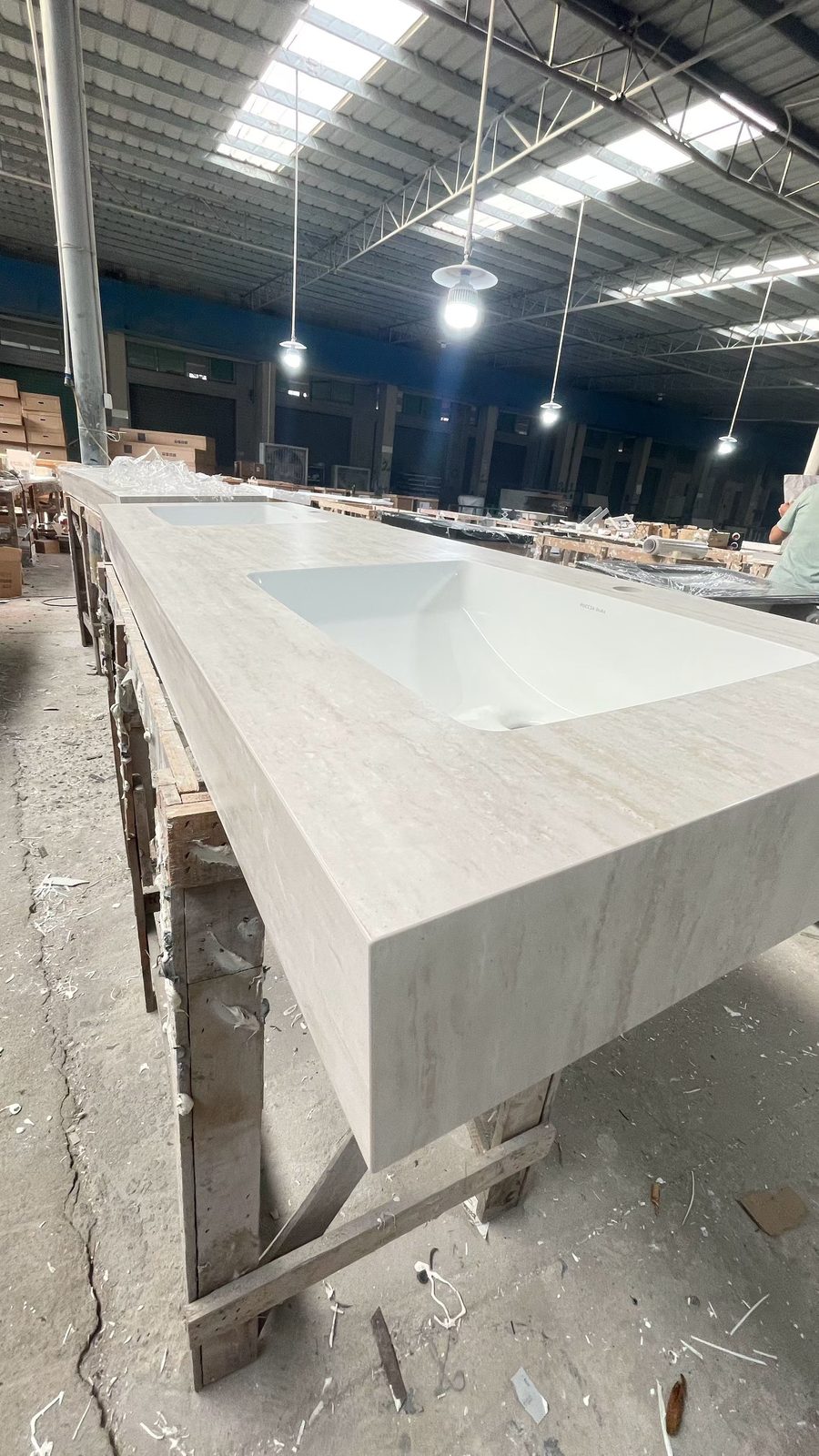
One-piece construction helps too. A continuous hot-bent curve has nothing to scrub around: one wipe, done. Fewer seams means fewer places for grime to anchor. Browse the hot-bent basin range for one-piece models in the standard 60–120 cm widths.
What works: the daily routine
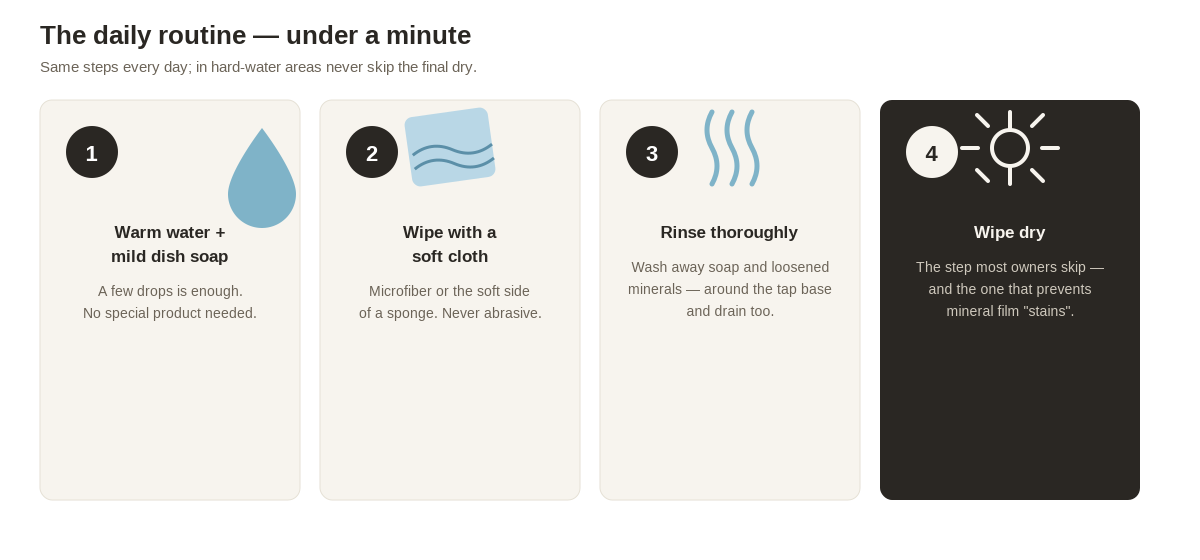
Daily care takes under a minute: wipe the basin with warm water, a few drops of mild dish soap, and a soft microfiber cloth, then rinse and dry. In hard-water areas the dry step matters — most “staining” complaints about white basins are mineral film from evaporating droplets, and rinse-and-dry prevents it.
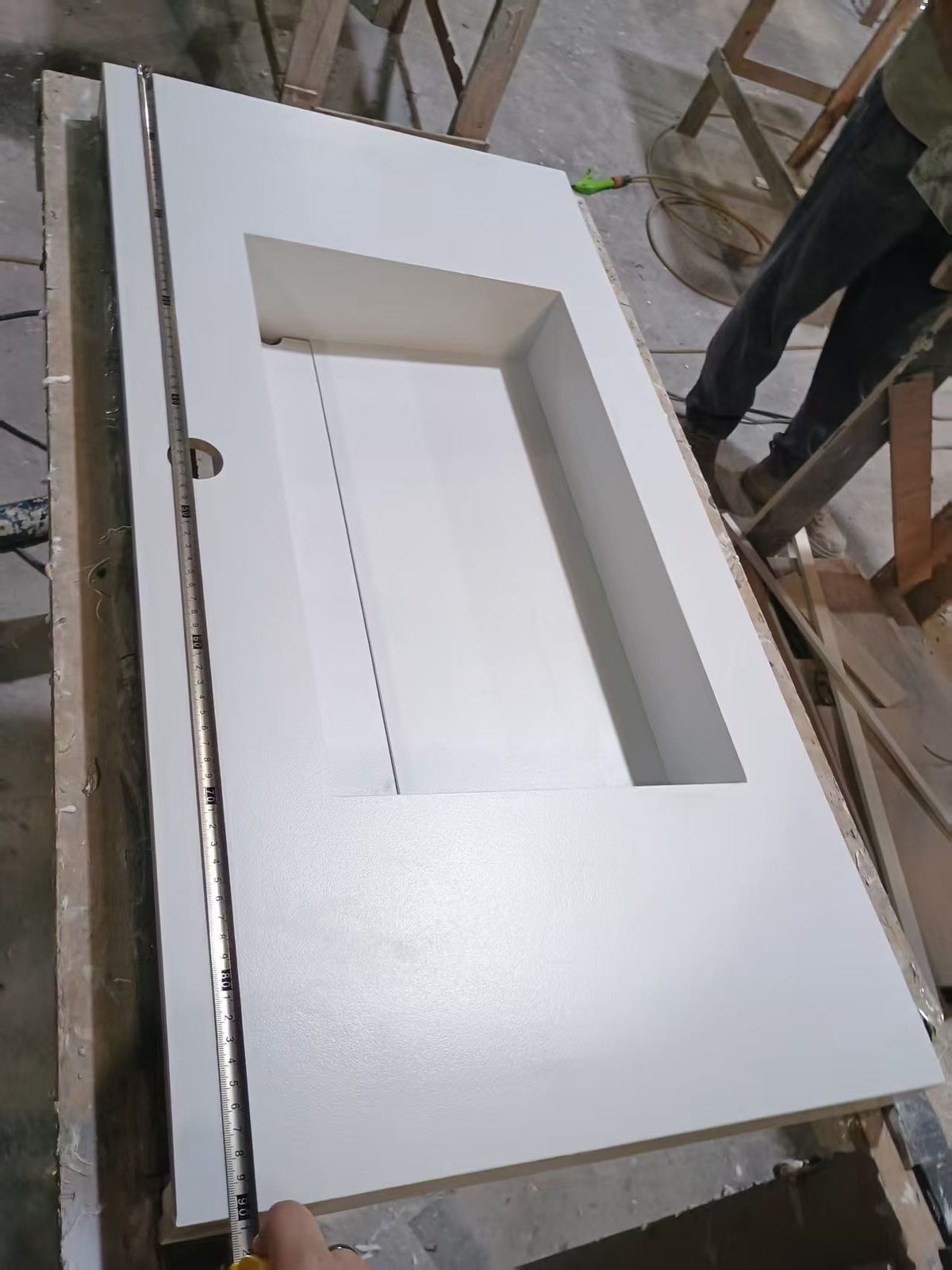
Our basins arrive with tap holes pre-drilled at the factory, so a quick wipe around the tap base keeps mineral crust from forming.
What works: weekly and spot fixes
Limescale is the most common complaint in hard-water regions. For mineral rings and dull scale film, soak a towel in diluted white vinegar, lay it on the spot for ten to fifteen minutes, then rinse thoroughly and wipe dry. Vinegar warnings in bathroom forums come from marble — one stone-restoration knowledge base documents an owner who etched a polished marble vanity by leaving a vinegar bottle on it. Sintered stone has no carbonate to etch, so household-strength vinegar works on scale without harming the stone. Rinse it off anyway; letting any liquid evaporate redeposits what you just dissolved.
Soap scum wipes off with the same routine. A doityourself.com forum member (September 2026) tried bathroom cleaner, Bar Keeper’s Friend, and polish on soap spots in a cultured-marble vanity with no change — but cultured marble is a porous, coated material, and that result does not transfer to sintered stone, where scum never soaked in to begin with. A surface film comes off with the daily cloth.
Toothpaste marks and makeup smudges respond to the same approach: work wet, use the soft side of a sponge, and finish with a dry cloth. The dry finish prevents the mineral spots that owners mistake for stains.
Treat dye urgently: hair color, strong toners, and some self-tanners can tint any light-colored basin. On sintered stone the pigment sits on the surface, so prompt action — water first, then mild soap — clears it. Left for hours, pigment in surface micro-texture takes longer to lift.
What buyers actually worry about
Cleaning anxiety is real — it drives some of the most active threads online. Three are worth hearing in the posters’ own words:
- “Help! This white sink was the worst decision!!” — a r/CleaningTips thread where an owner describes a white kitchen sink that “holds stains” and “always looks dirty” despite constant cleaning. The responses mostly converge on buildup: mineral film and soap residue, not staining into the material.
- “husband accidentally used harsh cleaner on copper sink with 15 years of patina” — a r/fixit thread (over 5,100 upvotes) where a lime-removing cleaner destroyed the patina on a copper sink. The lesson for sintered stone owners: the stone shrugs off the chemistry, but everything around it has a finish worth protecting.
- “Faucets ruined after home deep clean” — a r/CleaningTips thread (65 upvotes) where a professional deep clean dulled previously shiny faucets beyond fixing. In that thread, the faucet finish took the damage while the basin underneath stayed untouched.
The pattern across all three: damage lands on finishes — chrome, patina, glaze — more often than on the stone itself. Clean for the basin, and you will protect the hardware, the mirror, and the sealant at the same time.
What damages it
This is the honest half of the guide. Sintered stone is chemically quiet and physically hard, but careless handling still damages it.
Concentrated acids and alkalis. Hydrochloric-acid toilet cleaners, strong limescale removers left in place, and caustic drain openers poured directly into the bowl are the wrong tools. They will not dissolve the stone, but they can dull a polished finish and they attack the metalwork — tap finishes, drain covers, pop-up waste mechanisms — and the silicone sealant at the wall joint. For drain maintenance, use a plughole brush or a plumber’s snake, and keep chemical drain openers out of the basin.
Scouring pads and steel wool. The green scouring side of a sponge and steel wool scratch polished finishes. Matte finishes are more forgiving visually, but grinding abrasives remove material, and a scuffed polish cannot be restored with consumer products. If a scouring pad is the only thing in the house, reach for the soft sponge side and let the chemistry do the work.
Long bleach soaks. Brief contact with diluted household bleach does not harm the stone and can disinfect — but do not fill the basin with bleach solution and walk away. Bleach attacks tap finishes, mirror backing, and silicone, and corrodes some metal drain components over time. Wipe, rinse, done.
Dried-on cleaners. Whatever the cleaner, letting it evaporate on the surface concentrates it at the rim and tap deck — the most common cleaner damage is the right product left to dry. Always rinse and wipe dry.
Hard knocks. Dropped shampoo bottles and slipped tools chip edges. Chips are the one cleaning-adjacent problem you cannot wipe away: Deeper chips cannot be invisibly fixed — the pattern sits on the surface, so once it is gone, no polish brings it back. Handle the basin like stone, because it is stone.
Sealing: skip it
Sintered stone needs no sealing and no maintenance coating — a non-porous surface has nothing for a sealer to penetrate, so there is nothing to reapply. Natural stone demands resealing on a schedule, because its sealers wear off under daily use. An Australian distributor states it on LinkedIn exactly as dealers say it in showrooms: “Travertine, without the Travertine headaches… No sealing on ongoing maintenance, ever.” If a supplier tells you a sintered stone basin needs periodic sealing, question what they are actually selling.
When cleaning reveals a real problem
Sometimes a stubborn mark signals a real problem. Hairline cracks around a basin cutout point to support problems in the cabinet below — uneven support opens cracks around cutouts, corners, and seams. Milky patches that grow after wet cleaning on a natural-stone top are absorption, not residue. Knowing the difference saves owners from scrubbing at something no cleaner can fix.
Safe vs. avoid: the quick table
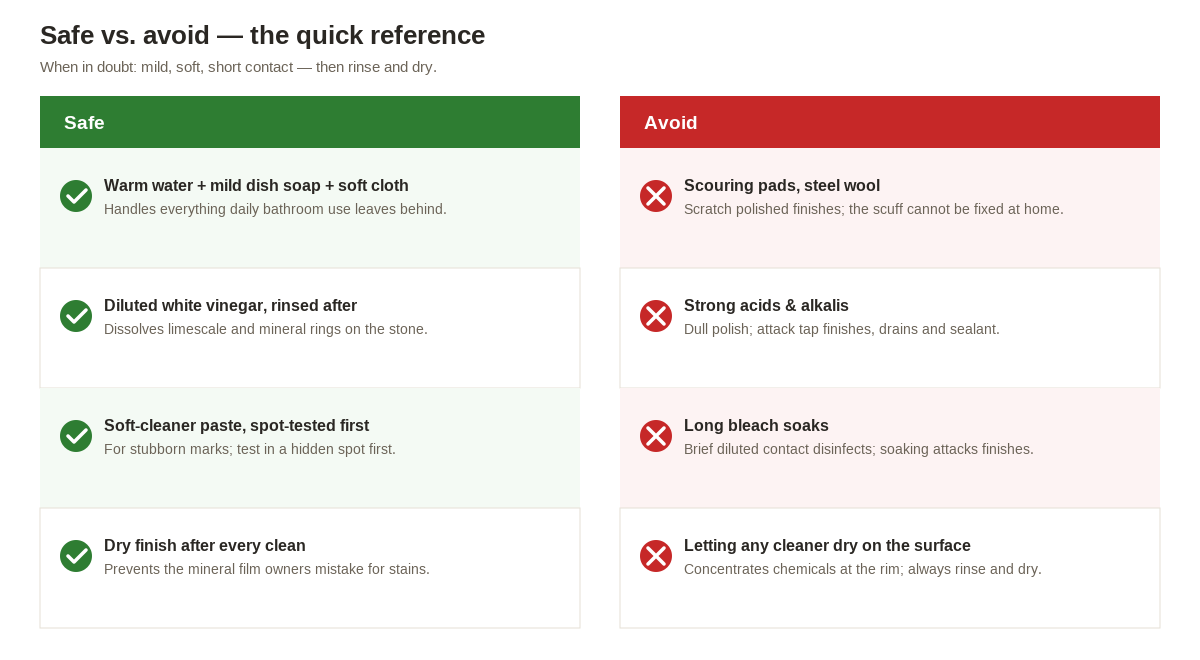
| Approach | Verdict | Notes |
|---|---|---|
| Warm water + mild dish soap + soft cloth | Safe daily | Handles daily grime with no effect on the finish |
| Diluted white vinegar, rinsed after | Safe for the stone | Dissolves limescale and mineral rings; always rinse and dry |
| Soft-cleaner paste, spot-tested | Use with care | Helps with stubborn marks; powder abrasives can dull polished finishes |
| Scouring pads, steel wool | Avoid | Scratch polished surfaces; a scuffed polish cannot be restored at home |
| HCl toilet cleaners, caustic drain openers | Avoid | Will not dissolve stone, but dull polish and attack hardware and sealant |
| Prolonged bleach soaking | Avoid | Brief diluted contact disinfects safely; soaking attacks finishes and sealant |
| Letting any cleaner dry on the surface | Avoid | Concentrates chemicals at the rim; always rinse and wipe dry |
FAQ
Can I use vinegar on a sintered stone basin? Yes, for short contact. Diluted white vinegar helps dissolve limescale and hard-water rings — lay a soaked towel on the spot, then rinse thoroughly and wipe dry. Vinegar warnings in forums come from marble: acid etches polished marble, and one stone-restoration knowledge-base case describes exactly that damage. Sintered stone has no carbonate to etch, so household-strength vinegar behaves differently here. Never leave any cleaner, vinegar included, to dry on the surface or on the hardware around it.
Will a white sintered stone basin stain? White sintered stone resists staining well because the fused mineral body absorbs almost nothing — marks sit on the surface and wipe off. The one honest exception is strong dye: hair color and similar pigments can leave a tint on any light-colored basin. Rinse those immediately. A much-discussed r/CleaningTips thread titled “Help! This white sink was the worst decision!!” is mostly a story about soap-scum film and mineral buildup left to accumulate, not about staining into the stone.
Can I use bleach on a sintered stone basin? Brief contact with diluted household bleach does not harm the stone and can disinfect. Do not soak the basin in it. Bleach attacks everything around the stone: tap finishes, metal drain covers, mirror backing, and silicone sealant. A viral r/CleaningTips thread — “Faucets ruined after home deep clean” — shows exactly that pattern: the fixtures dulled while the basin underneath was fine.
Does a sintered stone basin need sealing? No. There is nothing to seal into — the surface is non-porous through the body, unlike natural stone, whose sealers wear off under daily use and need reapplying on a schedule. An Australian distributor selling the category puts it bluntly on LinkedIn: “Travertine, without the Travertine headaches… No sealing on ongoing maintenance, ever.”
Is Bar Keeper’s Friend safe on a sintered stone basin? Use the soft-cleaner version sparingly and test first in an inconspicuous spot. The powdered, abrasive version and any scouring pad can dull a polished finish — that dulling is the one surface change you cannot wipe away. For routine work you do not need it: warm water, mild dish soap, and a soft cloth handle everything daily bathroom use leaves behind.
What if I chip the basin — can it be fixed? Prevention is the real answer: keep hard bottles away from edges and do not knock tools against the rim. If an edge chips, field repair is limited — deeper chips cannot be invisibly fixed, because the pattern sits on the surface, so once it is gone, no polish brings it back. Our separate guide explains what field repair can and can’t do.
Ask about the care requirements before you order
If you are specifying basins for a hotel, rental, or retail project, the cleaning routine above is also your maintenance-cost estimate: warm water, mild soap, no sealing, no specialist products. To compare finishes and basin styles, browse the basin range, explore configurations in the configurator, or send an inquiry with your widths and finish preferences.
Inquiries go to our Foshan sales desk and are used only for this inquiry — no mailing list, English reply.
Specifications verified against Vora Surfaces factory records. Editorial review applied. Spotted an error? Email corrections to vorasurfaces@gmail.com.
Frequently asked questions
Can I use vinegar on a sintered stone basin?
Yes, for short contact. Diluted white vinegar helps dissolve limescale and hard-water rings — lay a soaked towel on the spot, then rinse thoroughly and wipe dry. Vinegar warnings in forums come from marble: acid etches polished marble, and one stone-restoration knowledge-base case describes exactly that damage. Sintered stone has no carbonate to etch, so household-strength vinegar behaves differently here. Never leave any cleaner, vinegar included, to dry on the surface or on the hardware around it.
Will a white sintered stone basin stain?
White sintered stone resists staining well because the fused mineral body absorbs almost nothing — marks sit on the surface and wipe off. The one honest exception is strong dye: hair color and similar pigments can leave a tint on any light-colored basin. Rinse those immediately. A much-discussed r/CleaningTips thread titled 'Help! This white sink was the worst decision!!' is mostly a story about soap-scum film and mineral buildup left to accumulate, not about staining into the stone.
Can I use bleach on a sintered stone basin?
Brief contact with diluted household bleach does not harm the stone and can disinfect. Do not soak the basin in it. Bleach attacks everything around the stone: tap finishes, metal drain covers, mirror backing, and silicone sealant. A viral r/CleaningTips thread — 'Faucets ruined after home deep clean' — shows exactly that pattern: the fixtures dulled while the basin underneath was fine.
Does a sintered stone basin need sealing?
No. There is nothing to seal into — the surface is non-porous through the body, unlike natural stone, whose sealers wear off under daily use and need reapplying on a schedule. An Australian distributor selling the category puts it bluntly on LinkedIn: 'Travertine, without the Travertine headaches... No sealing on ongoing maintenance, ever.'
Is Bar Keeper's Friend safe on a sintered stone basin?
Use the soft-cleaner version sparingly and test first in an inconspicuous spot. The powdered, abrasive version and any scouring pad can dull a polished finish — that dulling is the one surface change you cannot wipe away. For routine work you do not need it: warm water, mild dish soap, and a soft cloth handle everything daily bathroom use leaves behind.
What if I chip the basin — can it be fixed?
Prevention is the real answer: keep hard bottles away from edges and do not knock tools against the rim. If an edge chips, field repair is limited — deeper chips cannot be invisibly fixed, because the pattern sits on the surface, so once it is gone, no polish brings it back. Our separate guide explains what field repair can and can't do.
Sourcing hot-bent basins for your next project?
Send your drawings and target quantities — we'll confirm feasibility from the factory floor.
Configure your inquirySee the products behind these guides: production cabinet styles and buying terms for buyers & OEM.
Specifications verified against Vora Surfaces factory records. Editorial review applied. Spotted an error? Email corrections to vorasurfaces@gmail.com.