
Factory guide
When Natural Stone Vanity Tops Fail: Water Spots, Cracks, and the Real Cost
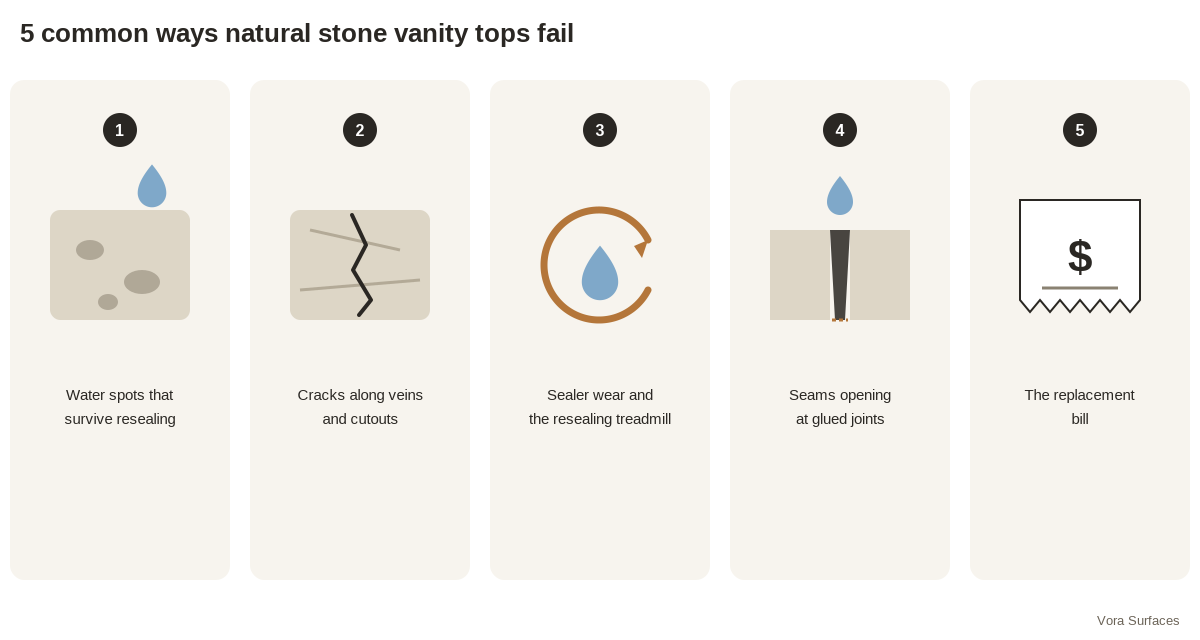
Natural stone vanity tops fail in predictable places: water spots soak into the stone itself, cracks open along veins and cutouts, sealers wear off under daily use, and seams widen until water gets behind the stone. The failure is rarely sudden — it is a slow accumulation that ends in a replacement bill far larger than the original quote.
By Vora Surfaces Factory Editorial Team · Published 2026-10-10 · Foshan, China
In short: Natural stone vanity tops fail mainly at the seams — water spots soak into the stone itself, cracks open along veins and cutouts, sealers wear off under daily use. Light-colored porous stone in a wet master bath is the riskiest combination; a low-moisture powder room with an owner who keeps up sealing is where natural stone still works.
A real failure, documented in 12 photos
In May 2026, a homeowner named Robin Evans-Kaufman posted a 12-photo complaint in a public Facebook group. Light-colored quartzite — vanity top and shower. The sealer, Hydroshield, had been applied twice. The water spots stayed. The seam between pieces had cracked. The supplier’s answer: upgrade to a pricier quartz, with the homeowner paying several thousand dollars in demo and reinstall labor on top of the new stone. In the comments, a stone-restoration company (MARBLELIFE) stepped in offering repair work — the only party in the thread positioned to gain from the failure.
That thread is the honest end state of a natural stone vanity top in a wet bathroom. What follows is the mechanism behind each of the five failures in those photos, what fixes genuinely exist, and where the honest line sits.
1. Water spots that sealing cannot stop
Light-colored quartzite looks clean and bright in the showroom, and that is exactly when it is most vulnerable. Porous stone wicks up mineral-laden water, and a bathroom runs on water. Sealers slow absorption, but the stone still takes on water at the faucet line and the basin edge. Hydroshield is a well-known name in the trade, and two professional applications is more than most homeowners ever commission. In the May 2026 case, the water marks survived them anyway.
A penetrating sealer sits inside the stone’s pores, and standing water, soap, and cleaning products still touch the surface every day. Over months, the sealer wears thin exactly where the water runs — around the faucet, along the basin edge, at the backsplash line. The spots that remain are minerals and moisture lodged inside the stone’s own structure, which is why household cleaners do nothing. A 2026 DIY-forum thread documents the same dead end with a different stone: “I’ve tried bathroom cleaner, BKF, and a polish… No change to the spots.” (DoItYourself.com thread, “Cleaning soap spots from cultured marble vanity”) At that point the stain is part of the stone, not a layer on top of it.
2. Cracks along veins, cutouts, and corners
Natural stone slabs carry veins and pattern variation, and fabricators cut sink openings and faucet holes into it. Those cuts create stress points: the corners of the cutout, the thin bridge of stone behind the faucet, the inside corner where the backsplash meets the deck. Hot water expands the stone slightly, cold water contracts it, and a bathroom runs that cycle every day.
Crack complaints are common on social media — short reels of real owners filming hairlines appearing months after installation. The cutout corners are where they start. An uneven cabinet underneath multiplies the stress: a stone top bridging an unsupported gap flexes microscopically every time someone leans on the rim, and installers across forums name that flex as a top crack pattern. (See The most common crack pattern in stone vanity tops has nothing to do with basin construction: uneven cabinet support creates stress points that hairline-crack the top around cutouts and corners — the support problem hits every material equally.)
3. The resealing treadmill
Sealers are consumables, and makers say so in the fine print. A penetrating sealer on a bathroom vanity gets worn down by hot water, cleaning products, and plain time, so most makers recommend reapplication within roughly a year in a hard-used bathroom. Run that over a decade of ownership and you are looking at roughly ten resealings — each with drying time and a bathroom partly out of service.
The catch the complaint thread exposed: resealing does not reverse staining that already happened. A fresh coat slows new absorption for a while; it does not lift the minerals already inside the pores. Homeowners who paid for a second professional application and watched the spots survive learn this the expensive way. The treadmill is prevention: it slows future absorption, and it does not repair past damage.
4. Seams opening at the joint
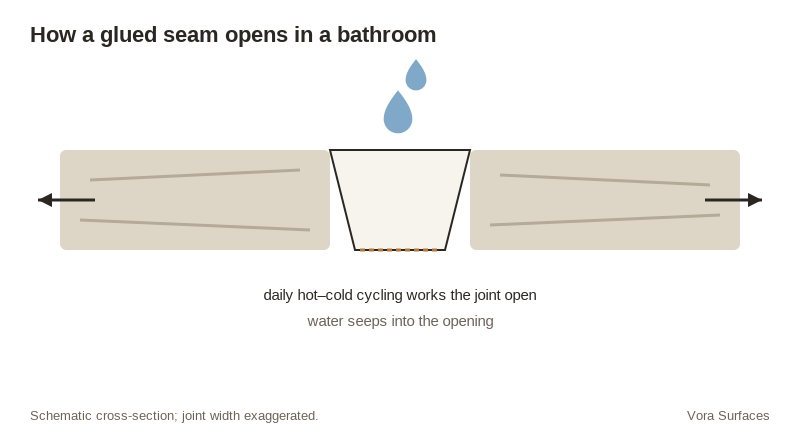
This is where the May 2026 case and our factory floor meet. The homeowner’s quartzite cracked at the seam. A stone vanity top is often two or more pieces joined with adhesive — the mitered joint behind the sink, the joint where the backsplash meets the deck. Adhesive ages under daily hot water and cleaning chemicals, and the stone moves microscopically around it. Water wicks behind the joint, feeds the stain and the flex, and the line darkens, widens, and eventually opens.
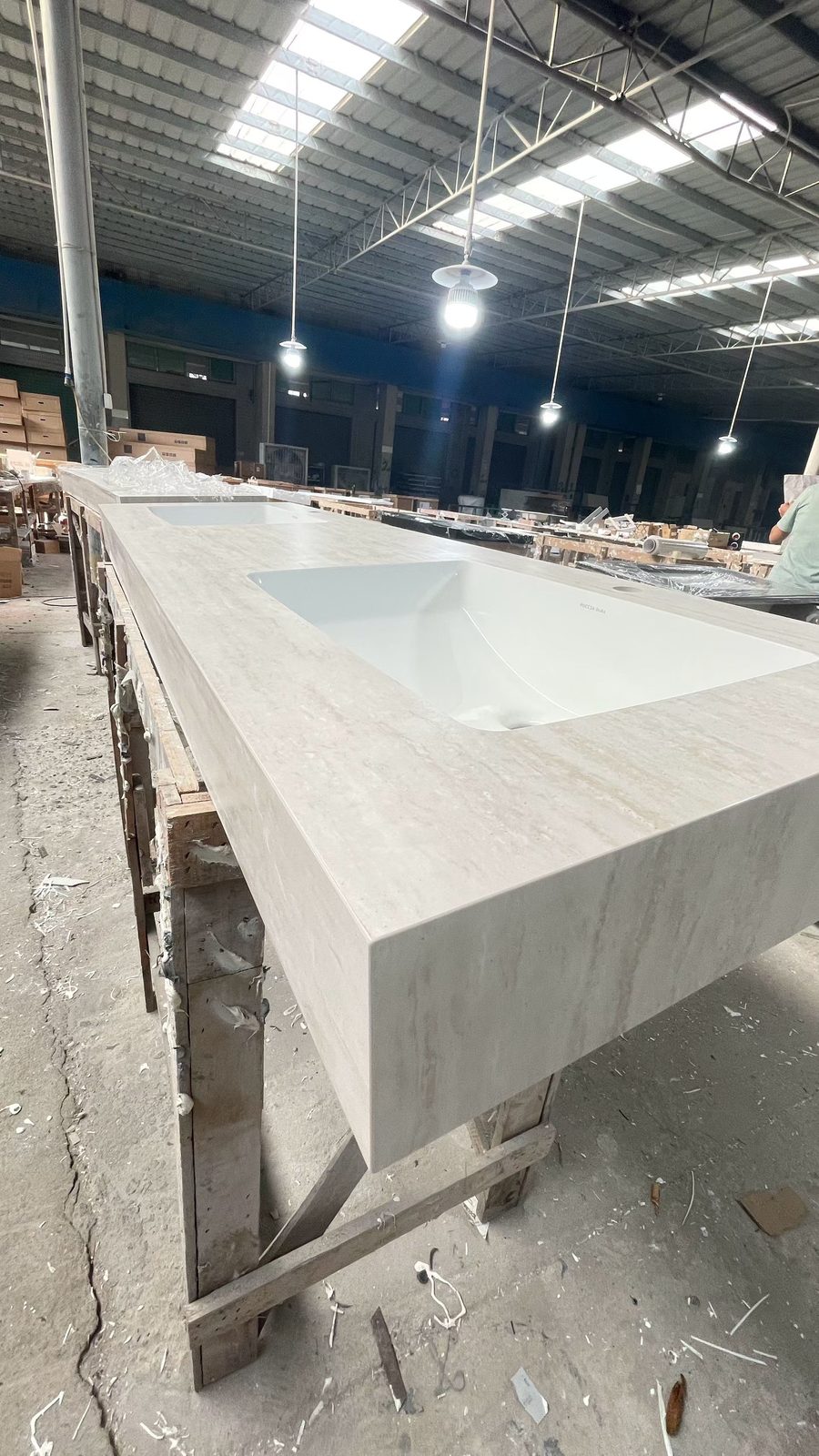
A basin bent from a single slab has no seam at the curve to open. A hot-bent sintered stone basin is a basin formed from a single sintered stone slab that is heated until pliable, bent over a mold, then cooled to lock in the curve. Our factory in Foshan does that bending in-house — the process the failed installation skipped entirely. It does not make the basin indestructible. It removes one failure line — the glued joint that failed in the photos.
5. The replacement bill nobody budgets for
The cruelest part of the May 2026 case is the arithmetic. The supplier would not replace like-for-like; the offered fix was a pricier quartz plus several thousand dollars of homeowner-paid demolition and reinstall. That is the real cost structure of natural stone failure: the stone is one line item. You pay for the old top’s removal, the plumbing disconnect, possible cabinet damage underneath (water that got through the seam sat there for months), the new top, and the new install. In a primary bathroom, add days without a working sink.
Compare that with what field repair can genuinely achieve on the stone itself: a tiny edge chip can be rounded off and re-polished by a skilled fabricator — but a cracked seam or a deeply stained top has no field fix that holds. The consistent advice from experienced stone buyers: demand replacement, document everything with photos and video, and treat a “95% fixed” offer as the seller’s discount on your problem.
| Failure | How it starts | What it typically costs you |
|---|---|---|
| Water spots | Minerals wick into porous stone; the sealer wears thin at water lines | Professional polishing or live with it — resealing does not reverse staining that already happened |
| Cracks | Stress concentrates at cutout corners, thin bridges, veins | Full top replacement — a crack has no lasting field repair |
| Sealer wear | Hot water, cleaners, and time thin the sealer; stains arrive between coats | Repeat professional visits, year after year |
| Seam failure | Adhesive ages under thermal cycling; water wicks behind the joint | Reglue in the short term; the joint is a recurring cost |
| Full replacement | Supplier offers pricier material; owner pays demo and reinstall | Several thousand dollars beyond the stone price |
When natural stone still makes sense
That does not mean banning marble from every bathroom. Natural stone stays the right call in specific conditions: a powder room with light, occasional use and low humidity; a homeowner who genuinely enjoys the patina and keeps up the sealing schedule; a design where nothing else matches the veining of that exact slab. The failure cases above cluster where they cluster — wet daily-use family and master bathrooms, light-colored porous stone, skipped maintenance schedules. Match the stone to the room, not the room to the stone.
And for the material question underneath it all: sintered stone’s resistance runs through the full thickness of the slab, because the material is minerals fused under heat and pressure. For the seam failure in the photos, a basin bent from a single slab has no joint to open.
Frequently asked questions
Can water spots on a natural stone vanity top be removed? Only if they sit on the surface. Mineral deposits and moisture that have soaked into porous stone are part of the stone now — polishing the face does not reach them. Light surface residue sometimes responds to a stone-safe cleaner; marks that survived two professional sealings are typically there to stay.
Do I need to seal a marble or quartzite vanity top? Yes, and plan to keep doing it. Sealers are consumables: hot water, cleaning products, and time wear them down, and most makers recommend reapplication within roughly a year in a hard-used bathroom. Sealing slows new absorption; staining that soaked in earlier stays inside the stone.
Why do stone vanity tops crack around the sink? The sink cutout concentrates stress: thin corners, the bridge behind the faucet, and any natural vein crossing the cut. Daily hot-then-cold thermal cycling works those points, and an uneven cabinet underneath multiplies the flex. Corners of cutouts are where the first hairline usually appears.
My stone top cracked after installation — should I accept a repair? No — insist on a replacement. A crack is structural damage, and epoxy or polish fills generally do not restore the load path; hot water and load are exactly what reopen a filled crack. Experienced stone buyers consistently advise documenting everything with photos and video, and declining partial “95% fixed” offers.
Is natural stone ever the right choice for a busy family bathroom? It can be, with eyes open: pick a darker, denser stone, budget for the resealing schedule, and accept that water marks become part of the look over time. The risky combination is light-colored porous stone in a wet master bath with no maintenance plan.
Talk to the factory before you spec the stone
If you are choosing a basin for a wet bathroom — for a project, a line, or a container — send us the room conditions and we’ll tell you straight whether our one-piece construction fits, or whether you should buy the natural stone you wanted and plan the maintenance around it. Browse the product range, test a layout in the configurator, or request a quote.
Who answers: the Vora Surfaces team at the Foshan factory. Your details are used for this inquiry only — no mass emails, no cold lists. A factory team member answers messages; if your question needs a check on the floor, we’ll say so and follow up from the floor.
Specifications verified against Vora Surfaces factory records. Editorial review applied. Spotted an error? Email corrections to vorasurfaces@gmail.com. Published 2026-10-10 · Last verified 2026-10-10.
Frequently asked questions
Can water spots on a natural stone vanity top be removed?
Only if they sit on the surface. Mineral deposits and moisture that have soaked into porous stone are part of the stone now — polishing the face does not reach them. Light surface residue sometimes responds to a stone-safe cleaner; marks that survived two professional sealings are typically there to stay.
Do I need to seal a marble or quartzite vanity top?
Yes, and plan to keep doing it. Sealers are consumables: hot water, cleaning products, and time wear them down, and most makers recommend reapplication within roughly a year in a hard-used bathroom. Sealing slows new absorption; staining that soaked in earlier stays inside the stone.
Why do stone vanity tops crack around the sink?
The sink cutout concentrates stress: thin corners, the bridge behind the faucet, and any natural vein crossing the cut. Daily hot-then-cold thermal cycling works those points, and an uneven cabinet underneath multiplies the flex. Corners of cutouts are where the first hairline usually appears.
My stone top cracked after installation — should I accept a repair?
No — insist on a replacement. A crack is structural damage, and epoxy or polish fills generally do not restore the load path; hot water and load are exactly what reopen a filled crack. Experienced stone buyers consistently advise documenting everything with photos and video, and declining partial '95% fixed' offers.
Is natural stone ever the right choice for a busy family bathroom?
It can be, with eyes open: pick a darker, denser stone, budget for the resealing schedule, and accept that water marks become part of the look over time. The risky combination is light-colored porous stone in a wet master bath with no maintenance plan.
Sourcing hot-bent basins for your next project?
Send your drawings and target quantities — we'll confirm feasibility from the factory floor.
Configure your inquirySee the products behind these guides: production cabinet styles and buying terms for buyers & OEM.
Specifications verified against Vora Surfaces factory records. Editorial review applied. Spotted an error? Email corrections to vorasurfaces@gmail.com.