
Factory guide
Why Stone Vanity Tops Crack: 5 Installation Mistakes
A stone vanity top cracks when installation concentrates load on one weak point: an unsupported span, a cutout edge, or a fixing that holds the stone rigid while the cabinet moves. Stone carries even load across its face well and point load at edges and cutouts poorly. The five mistakes below each create that kind of point load, with a check that catches it before sealant hides it.
By Vora Surfaces Factory Editorial Team · Published 2026-10-27 · Foshan, China
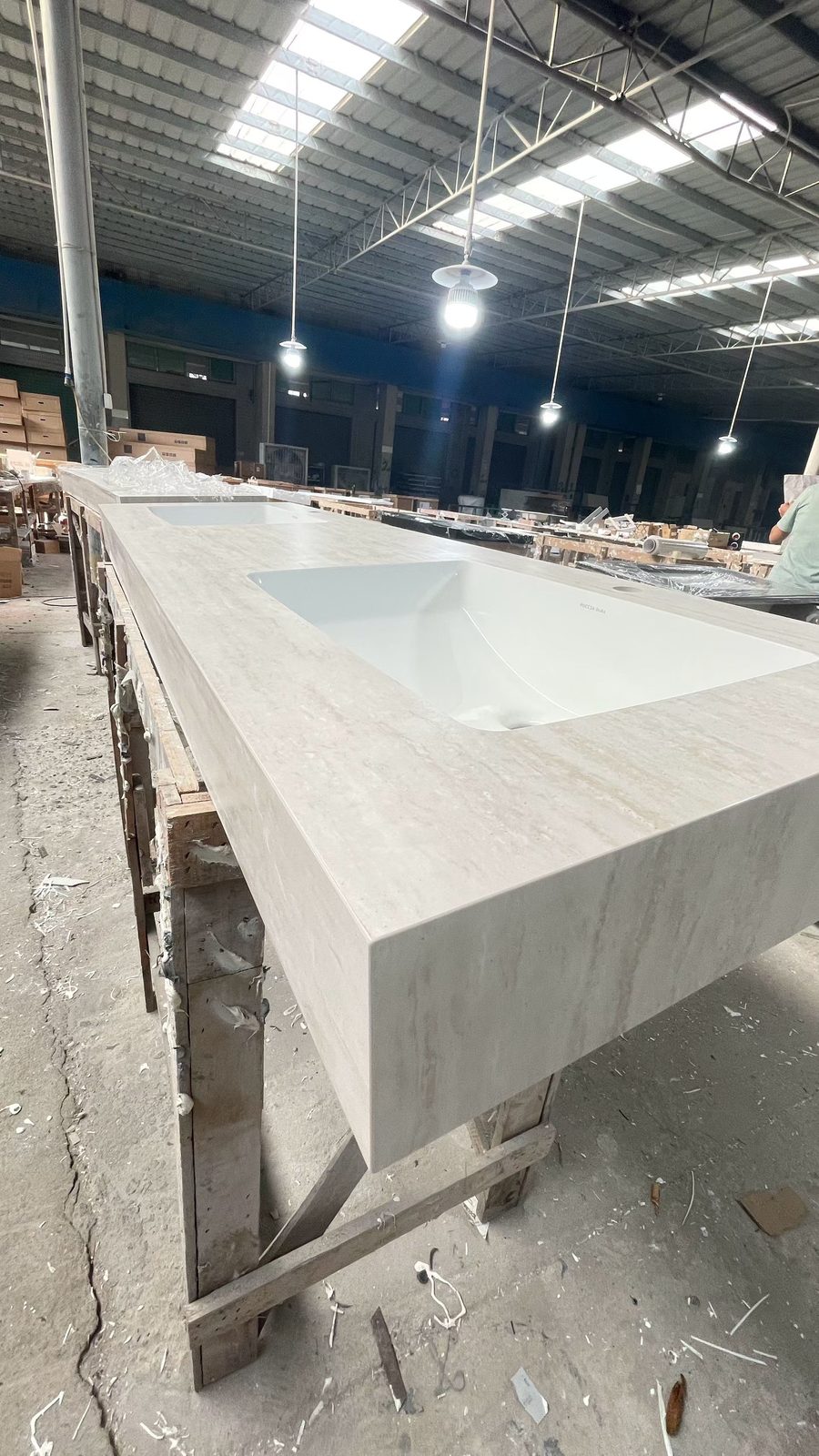
The five mistakes at a glance
| Mistake | Stress point | Check |
|---|---|---|
| Uneven or unsupported cabinet | Cutouts, corners, seams | Level both ways, full contact |
| Wall-hung fixing into a weak wall | Mounting rail, top rear edge | Fixing plan vs blocking or masonry |
| Forcing a top onto an out-of-square cabinet | Drain cutout, basin curve | Dry fit, drain alignment measured early |
| Overtightening and rigid fixing | Tap holes, drain flange, wall joint | Hand-tight plus a small turn, flexible wall sealant |
| Skipping the delivery inspection | Whole top, edges, crate corners | Crate and surface check before signing |
Mistake 1: An uneven or unsupported cabinet
This is the failure mode installers describe again and again. An installation guide for stone vanity tops puts it plainly: “Uneven or incomplete support… creates hairline cracks around cut-outs, corners, and seams.” A Reddit thread in r/AusProperty titled “Engineered Stone benchtop sinking and cracking” drew 52 comments from owners tracing the same pattern.
The mechanism is simple. A one-piece top is rigid, so it bridges a dipping or twisting cabinet and the load concentrates where the stone touches: at the high points, at the cutout edges, at the corners. Over weeks of daily use, a hairline crack opens at the loaded edge.
The check is a level in both directions, read on the cabinet frame where the stone will rest. Shim under the cabinet feet or plinth until the bubble centers both ways — never under the stone, where a shim creates a high point of its own. Then dry-fit the top and check full contact across the footprint: a top that rocks on the cabinet is a top waiting for a crack.
Cabinet construction matters here. Vora cabinet bodies are solid wood with moisture-proof treatment, which helps a cabinet hold its shape in bathroom humidity. A cabinet that swells or twists with moisture changes the support under the stone, so the moisture-proof body is part of the crack story. Our step-by-step installation guide walks through the levelling sequence for wall-hung and floor-standing units.
Mistake 2: A wall-hung unit fixed into a weak wall
A wall-hung vanity transfers the whole load — cabinet, stone top, basin water, stored items — into the wall through its mounting rail. When the rail goes into hollow drywall with standard anchors, the fixing creeps and the cabinet tilts forward, loading the top unevenly. The Reddit question in r/AusRenovation — “What trade to fix Bathroom Vanity (Sink Cabinet) coming off the wall?” — is this mistake after the fact.
Wall preparation belongs before the tiler closes the room. On stud walls, add horizontal blocking between studs at rail height, or fix into masonry or concrete where the building allows. Confirm the wall structure and the fixing plan before delivery day, and size the fixings for the combined load of the unit.
On an uncertain wall, a floor-standing unit sidesteps the question: the floor carries the load. Vora states no weight ratings for wall fixings, since actual load depends on unit size and wall construction.
Mistake 3: Forcing a top onto an out-of-square cabinet or a misaligned drain
Two separate misalignments cause the same damage. A cabinet that is out of square leaves one corner of the top high and the opposite corner unsupported. Forcing the top down onto the high corner loads the stone at exactly the point where it touches, and the crack that follows often starts at the nearest cutout.
Drain misalignment does similar damage through the drain flange. A Reddit r/askaplumber thread — “Existing drainage doesn’t line up with new vanity” — drew 30 comments from remodelers whose new basin sat inches from the old waste pipe. A trap pulled sideways to meet an offset waste line tugs at the drain flange. A JustAnswer plumbing question captures the matching confusion: “What is the trick to getting the right PVC drain pieces?”
Measure the offset between the old waste pipe and the new basin drain before the installer arrives. Bridge a small offset with a trap adapter or an adjustable P-trap arm. For a larger offset, reroute the waste line in the wall or floor. The reroute costs less than a replacement top.
Order-time details prevent a second version of this mistake. Vora basins leave the factory with tap holes pre-drilled to mainstream mixer tap specs, so confirm hole count, hole sizing, and drain type at order time. Hole positions are fixed once the stone is cut.
Mistake 4: Overtightening and rigid fixing with no movement allowance
This section states general installer guidance. Stone, cabinet, and wall move at different rates, and a fixing that locks all three together transfers every movement into the stone.
Overtightening is the clearest version. A drain locknut or tap fixing tightened past hand-tight plus a small turn squeezes the stone around the hole, where the stone is thinnest. Tighten by hand plus a quarter turn, then test for leaks under full flow.
Rigid adhesive between top and cabinet creates the slower version. A hard glue line turns the cabinet into a lever on the stone: when the cabinet shifts, the stone takes the movement. A flexible bead of neutral-cure silicone at the wall junction absorbs small movement while keeping splash water out of the gap. Fix the cabinet to the wall, let the top rest on full cabinet support, and seal the room junction with a flexible joint.
Mistake 5: Skipping the delivery inspection
The delivery inspection decides whether a cracked arrival is a clean replacement claim or a dispute. A Wayfair buyer, Andrea from Hamburg, PA, described the pattern: “arrived cracked all the way across. Wayfair customer services was great, but waiting for the replacement took a few weeks.” A gethuman.com complaint tells the sharper version: “the bathroom vanity I ordered arrived broken twice… my construction plans are now on hold.” A Reddit r/CounterTops thread — “Countertop came cracked, installers don’t want to replace it” — drew 369 upvotes and 138 comments.
A signature on a cracked top turns a replacement claim into an argument. Inspect before signing:
- Check the crate: crushed corners or broken slats mean the shipment took a hit.
- Lift the top out with two people and lay it flat on a clean surface, never propped on a corner.
- Scan the whole surface for cracks, especially near the basin curve and tap holes.
- Check the edges for chips, and set the top on a flat floor to test for rocking.
- Photograph any damage with the crate still in frame, and notify the supplier the same day.
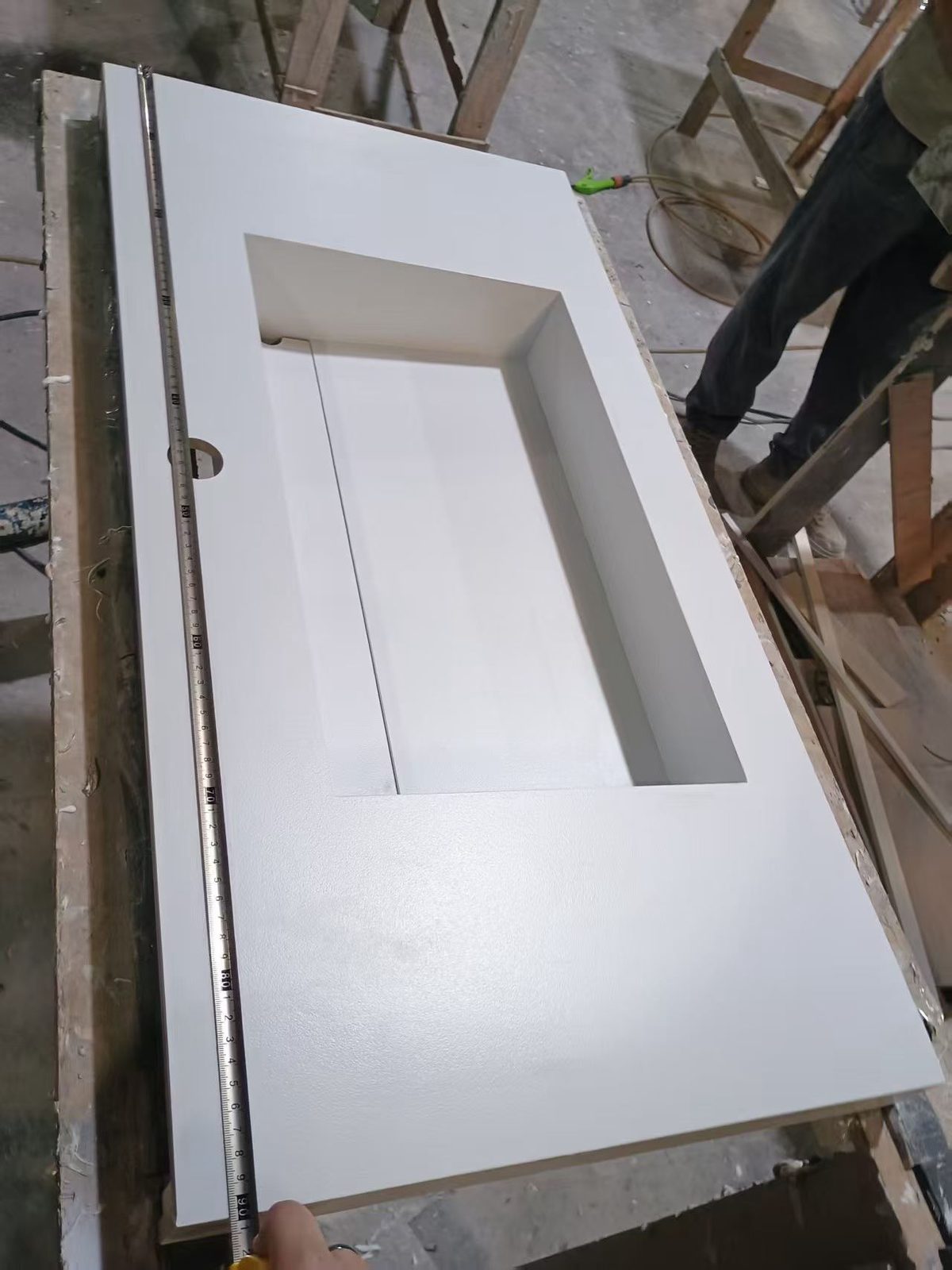
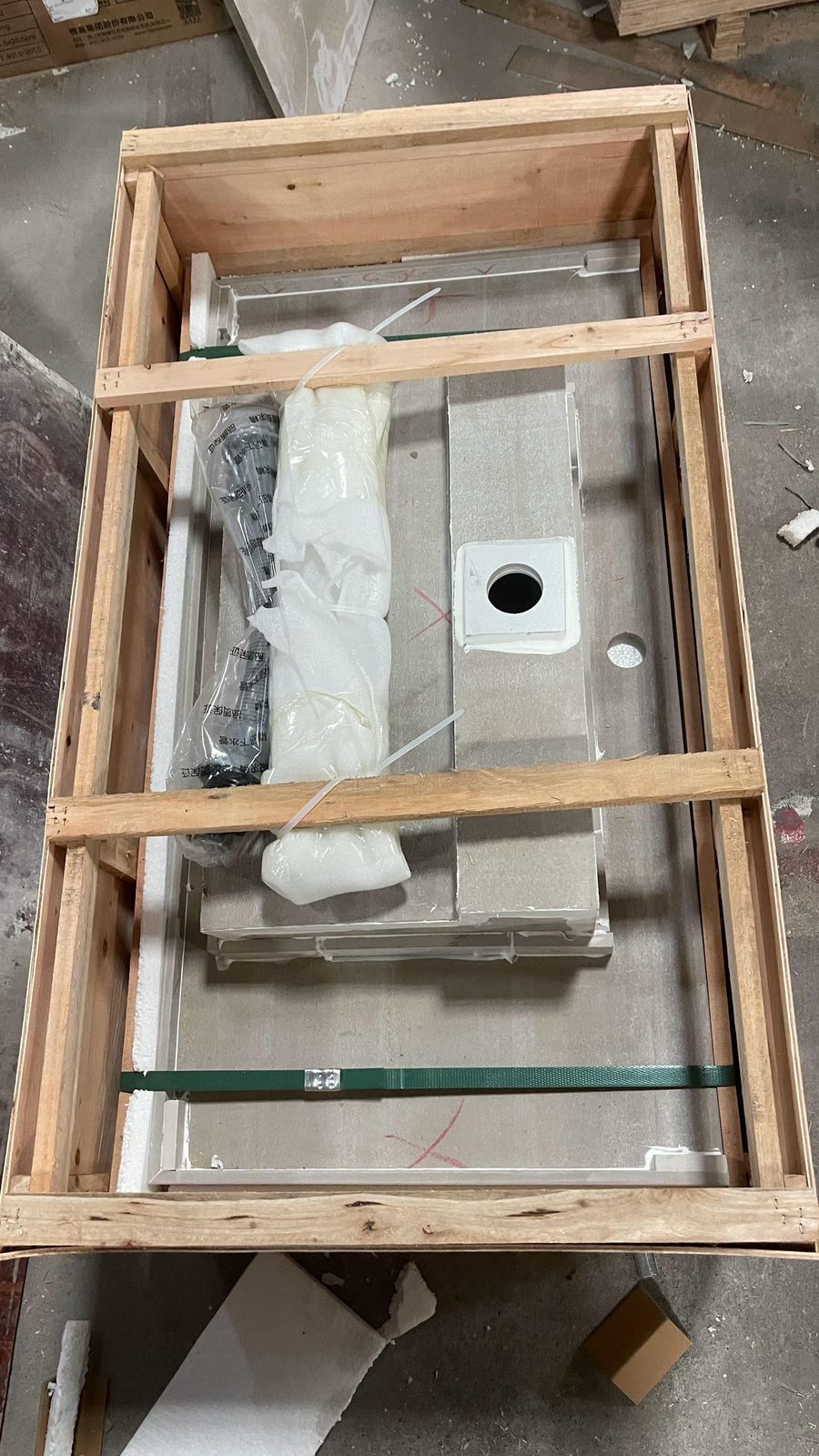
Vora factory practice gives the inspection a solid starting point. Each basin top gets a tape-measure check against its spec before packing, so what leaves the factory is dimensionally correct. Packing is protective foam plus a wooden crate with internal framing and strapping. A measured and crated top still needs the arrival check: transit is where the damage in the buyer quotes above happened. Our delivery inspection checklist covers the full sequence.
Honest limitations
A stone top on full, level support serves a main bathroom well.
- Weight. A one-piece stone top is heavy, and a wall-hung unit transfers that weight to the wall. We state no weight ratings: load depends on unit size and wall construction.
- Edges chip. Stone is hard across its face and brittle at its edges. Impact at a sharp point can chip an edge, and deep damage has real limits on repair. Protect edges through the rest of the renovation.
- A crack across the top means replacement. Small edge chips can sometimes be rounded and re-polished. A crack through the body of the stone cannot be polished away. Our repair guide sets out which damage is workable and which means replacement.
- Hole layouts are decided at order time. Tap holes are cut at the factory. Confirm tap model, hole count, and drain type at order time, since tap-hole positions are fixed after cutting.
- Sizes are a showroom reference. Vora common vanity widths run 60–120 cm, and the showroom slab size and thickness chart lists sizes up to 1600×2800 mm and thicknesses of 6, 11, and 12 mm. Confirm the format for a specific order at order time.
Frequently asked questions
Why does a stone vanity top crack around the sink cutout?
A cutout removes material where the stone already carries load from the basin, the tap, and daily use. Uneven cabinet support turns that edge into a stress point, and a hairline crack follows the cutout. Full, level support, plus a dry fit before sealant, keeps load spread across the stone.
Why is my benchtop sinking and cracking?
A sinking benchtop points to support failure under the stone: a cabinet out of level, a sagging span, or a wall fixing that has given way. Stone follows the support beneath it, so a dip loads the edges and the cutouts. Fix the support and re-level the cabinet before judging the stone.
My vanity top arrived cracked. Who pays for the replacement?
Photograph the damage with the crate still in frame and notify the supplier the same day, before signing a clean delivery receipt. A signed clean receipt turns a transit claim into an argument about when the crack happened.
Do I need an experienced installer for a sintered stone vanity?
Yes. As one Reddit commenter warned: ‘Sintered stone can be durable but you have to find a very experienced installer otherwise you may have problems down the road.’ The plumbing is standard work. The specialist part is the support, the wall fixing, and the dry fit.
Can a cracked stone vanity top be repaired?
Small edge chips can sometimes be rounded and re-polished. A crack across the top runs through the body of the stone and cannot be polished away. Our repair guide sets out which damage is workable and which means replacement.
Get the installation right
A cracked top is usually an installation story: support, fixing, alignment, torque, and the delivery check cover the failure modes in this guide. Vora hot-bent vanities are bent in-house at the Foshan factory, measured against spec before packing, and shipped foam-wrapped in a wooden crate with internal framing and strapping. Pair that unit with a level cabinet and an experienced installer.
If you are specifying a unit for a project, tell us the basin size, hole layout, and mounting type so factory details can be confirmed against your order sheet before cutting.
When you send an inquiry, it goes to the Vora Surfaces team inbox at vorasurfaces@gmail.com or through the inquiry form. It is used only to reply to this inquiry: you are added to no mailing list, and your details are shared with no one. We state no response time here.
Frequently asked questions
Why does a stone vanity top crack around the sink cutout?
A cutout removes material where the stone already carries load from the basin, the tap, and daily use. Uneven cabinet support turns that edge into a stress point, and a hairline crack follows the cutout. Full, level support, plus a dry fit before sealant, keeps load spread across the stone.
Why is my benchtop sinking and cracking?
A sinking benchtop points to support failure under the stone: a cabinet out of level, a sagging span, or a wall fixing that has given way. Stone follows the support beneath it, so a dip loads the edges and the cutouts. Fix the support and re-level the cabinet before judging the stone.
My vanity top arrived cracked. Who pays for the replacement?
Photograph the damage with the crate still in frame and notify the supplier the same day, before signing a clean delivery receipt. A signed clean receipt turns a transit claim into an argument about when the crack happened.
Do I need an experienced installer for a sintered stone vanity?
Yes. As one Reddit commenter warned: 'Sintered stone can be durable but you have to find a very experienced installer otherwise you may have problems down the road.' The plumbing is standard work. The specialist part is the support, the wall fixing, and the dry fit.
Can a cracked stone vanity top be repaired?
Small edge chips can sometimes be rounded and re-polished. A crack across the top runs through the body of the stone and cannot be polished away. Our repair guide sets out which damage is workable and which means replacement.
Sourcing hot-bent basins for your next project?
Send your drawings and target quantities — we'll confirm feasibility from the factory floor.
Configure your inquirySee the products behind these guides: production cabinet styles and buying terms for buyers & OEM.
Specifications verified against Vora Surfaces factory records. Editorial review applied. Spotted an error? Email corrections to vorasurfaces@gmail.com.