
Factory guide
Childproofing the Vanity: Magnetic Locks, Medicine Safety, and What's Actually Stored Under the Sink
Childproofing a bathroom vanity means controlling what a small child can reach once the cabinet door opens. The vanity cabinet holds medicines and cleaning products in one place, at a height a crawling or climbing child can reach. A childproof vanity pairs a lock on the cabinet door with storage habits that keep the most dangerous items out of reach even when the lock opens.
By Vora Surfaces Factory Editorial Team · Published 2026-11-20 · Foshan, China
Why the lock goes on the door
Parents usually fit a cabinet lock after the child starts climbing, when the cabinet has already stood open for months. The worry is rarely the cabinet tipping over — it is what the child finds after the door swings open.
Social video shows the moment parents act. On 28 July 2026, @pov.father posted a clip of himself fitting a $20 adhesive child lock from Amazon to a bathroom vanity, saying he no longer worried about his child opening the cabinet and drinking something harmful. It cost little, fitted in minutes, and answered the exact fear: a child opening the door and reaching a bottle.
A baby-proofing video by Trimiesha Joyner (25 February 2025, about 350,000 likes and 15,000 comments) lists a hidden latch lock under the sink as essential. Comments split two ways: parents asking for the link, and parents saying their child learned to open the lock within two days — demand for an invisible lock, and proof that a lock is a delay a watching child will learn.
A magnetic lock demonstration posted 11 May 2026 films the lock against cleaning spray bottles, describing it as a way to keep dangerous products away from toddlers. A DreamWerks mirror cabinet advertisement from 28 September 2026 leads with keeping medicines and razors safe from young children; a short safety clip shared on Facebook on 3 November 2026 opens on prescription bottles tipped over on a cluttered counter. Pediatric emergency doctor Dr. Beachgem10, Safe Kids Worldwide, and the U.S. Consumer Product Safety Commission have all campaigned on the same theme: medicines within children’s reach, including pills that look like sweets and doses left in a grandparent’s bag.
The shared thread is simple: parents fear the contents, and locks need upgrading as the child grows.
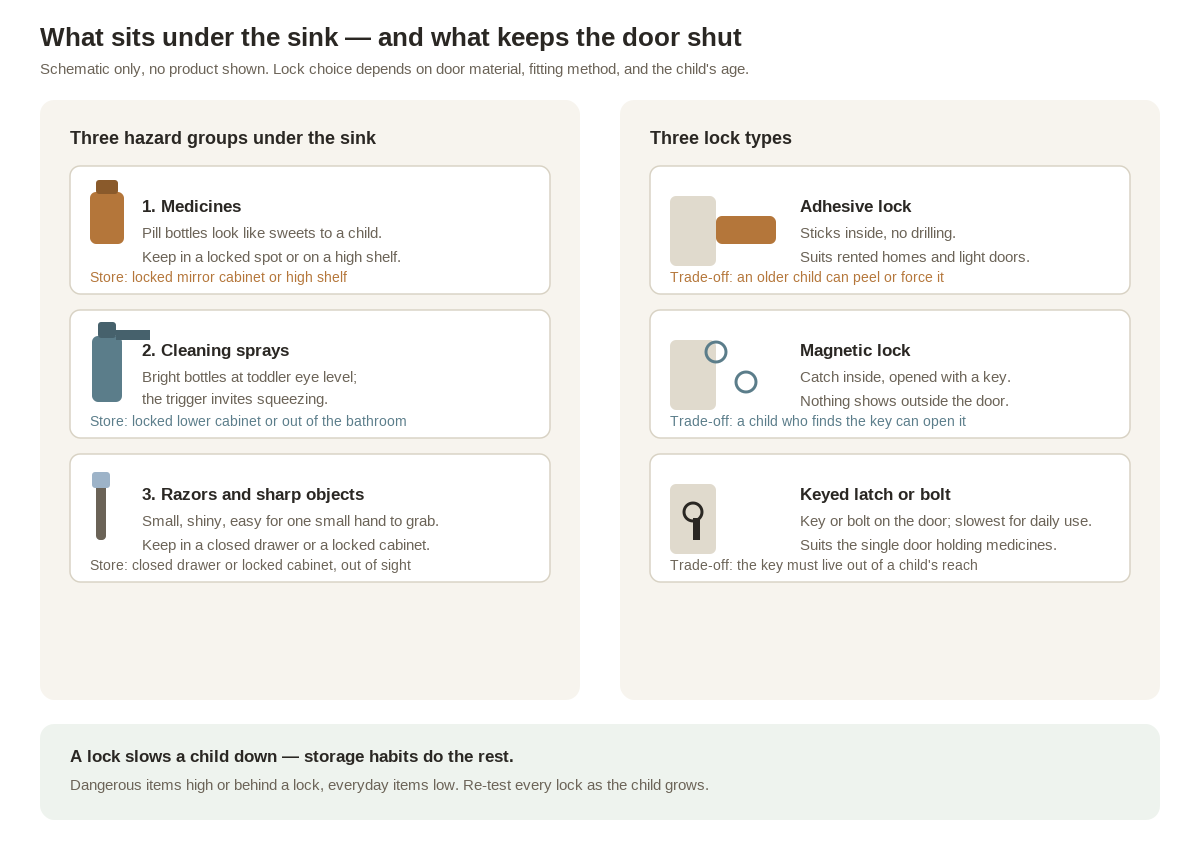
Three hazard groups under the sink
A vanity cabinet concentrates the most dangerous ordinary items in a home into one small space.
| Hazard group | Why it draws a child | Common storage mistake |
|---|---|---|
| Medicines | Pill bottles look like sweets | Loose bottles on a low shelf |
| Cleaning sprays | Bright bottles at eye level, with a trigger | Spray bottle beside the basin |
| Razors and sharp objects | Small, shiny, easy to grab | Razor on a low shelf |
Medicines. The risk is a child swallowing a dose meant for an adult. Campaigns point to two patterns: pill bottles that look like sweets, and medicines carried in a visitor’s bag and set on a counter. A vanity shelf holds the family’s bottles in one place, easy for adults and children alike to find. The fix is a locked spot or a high shelf, and a habit of putting a visitor’s bag out of reach on arrival.
Cleaning sprays. A spray bottle under the sink sits at toddler eye level, and the trigger invites squeezing. A bottle kept beside the basin is worse, because it sits outside the cabinet entirely. Store sprays inside a locked cabinet, and wipe up drips as part of the regular routine — a weekly wipe-down and a deep clean every two weeks catches a leaking bottle before the cabinet floor turns sticky.
Razors and sharp objects. Razors, nail scissors, and tweezers fit in one small hand, and they tend to live where adults last used them: a low shelf, an open tray, the basin edge. A closed drawer or a locked cabinet keeps them out of sight, and out of sight is half the job with a toddler.
A closed cabinet brings one more consideration: damp air builds up behind a shut door, feeding mold that grows from damp air trapped in a closed cabinet. Keep the cabinet dry, wipe spills promptly, and keep medicines in their original packaging.
Medicine storage and poisoning response follow local rules and a doctor or pharmacist’s advice. This guide covers storage and lock choices only.
Three lock types, compared
No lock type suits every cabinet: each trades fitting ease against how hard a child can defeat it, and each has a fitting requirement worth checking before buying.
| Lock type | Fitting | Hidden from view | How a child defeats it | Suits |
|---|---|---|---|---|
| Adhesive lock | Sticks inside, no drilling | A small catch shows | Peeling or forcing it | Rented homes, light doors |
| Magnetic lock | Catch inside, key-opened | Yes, nothing shows outside | Finding the key | Doors that must look clean outside |
| Keyed latch or bolt | Key or bolt on the door | No, the fitting shows | Needs the key, kept out of reach | The medicine door |
Adhesive locks. These are usually among the cheapest and quickest to fit — the $20 lock in the @pov.father video is an adhesive one — and they stick inside the door with no drilling, so they suit rented homes and light doors. The trade-off is hold: an older child can peel or force a catch, and the adhesive needs a clean, flat surface to grip. Check the door material first, and follow the lock maker’s fitting instructions.
Magnetic locks. A magnetic catch sits inside the cabinet and opens with a key held against the door, and nothing shows outside — which is why parents in the Joyner video comments asked for the link. The weakness is the key: a child who finds it, or who watches an adult use it, can open the lock. Keep the key high and out of sight, and treat a magnetic lock as a delay.
Keyed latch or bolt. A keyed lock or sliding bolt is generally the hardest of the three for a child to force open, and is the slowest for an adult to use daily, so it suits the single door holding medicines, where slow access is a fair price for a stronger hold. The key must live out of a child’s reach, and every adult in the home needs to know where it is.
Locks are designed to slow a child down and help reduce the chance of a child reaching dangerous items — one layer, working with storage habits: high shelves, locked mirror cabinets, and dangerous items kept apart from everyday ones.
Where medicines and cleaners go
The rule is short: dangerous items go high or behind a lock, everyday items go low, so a child who opens the wrong door meets toothpaste and soap.
- Medicines go in a locked mirror cabinet or on a high shelf. A mirror cabinet keeps them at adult eye level behind a door, and a locking style adds a second barrier — confirm the style before ordering, since locking styles are a buyer specification.
- Cleaning products go in a locked lower cabinet, or out of the bathroom entirely. A high shelf works too, but a locked cabinet keeps sprays beside the basin.
- Everyday items — toothpaste, soap, hairbrushes — stay on the open shelves. Separated from dangerous items, they mean a child who opens a door meets the safe shelf first.
- Visitor bags and loose pills go out of reach on arrival. A bag set on the counter puts medicine at counter height, which is climbing height for a toddler.
When a child learns the lock, the storage plan matters more: a lock that opens still leaves medicines high and cleaners behind a second door.
When your child learns the lock
Expect it. Commenters on the Joyner video said their children learned to open the hidden latch within two days — individual reports, not a rule, since performance varies with door material, fitting method, and the child’s age. The lesson is that learning happens, and the response is an upgrade.
The upgrade path has four steps, in order:
- Change the lock type on the medicine door: adhesive to magnetic, or magnetic to a keyed latch.
- Move the items higher: medicines go to the top shelf of a locked mirror cabinet, or out of the bathroom.
- Add a second lock to the same door, so opening it takes two different actions.
- Re-test after every change: watch what the child can reach from a step stool, with an adult present, and check the catch holds.
Re-check every few months: a lock that held at eighteen months may fail at three years, as the child grows taller, stronger, and better at watching adults.
Ordering and fitting checklist
Use this list before ordering and again after fitting.
- List every door and drawer a child can reach, and mark which ones hold medicines or cleaners.
- Pick a lock type per door, keeping the medicine door on the strongest option.
- Check the door material against the fitting method: adhesive locks need a clean, flat surface, and magnetic catches need a door and frame that accept the catch.
- Confirm the mirror-cabinet style before ordering, including whether a locking style is available as a buyer specification.
- Fit the locks, then test them: pull each door, watch a child try from a stool with an adult present, and check every catch holds.
- When the vanity arrives, check doors, hinges, and lock mounting points as part of what to check when your vanity arrives — a door that hangs unevenly can leave a gap a small hand fits through.
What dealers can ask families
One question before ordering changes the conversation: “How old are your children?” Asked early, it turns the lock from an afterthought into a specification item, decided with width, finish, and basin style — and the buyer leaves with locks on the order, not a hardware-store trip after fitting. It also sets expectations honestly: locks slow a child down and need upgrading as the child grows, and explaining that gives the family a plan for after the first lock is learned.
Vora Surfaces: cabinets and mirror cabinets for family bathrooms
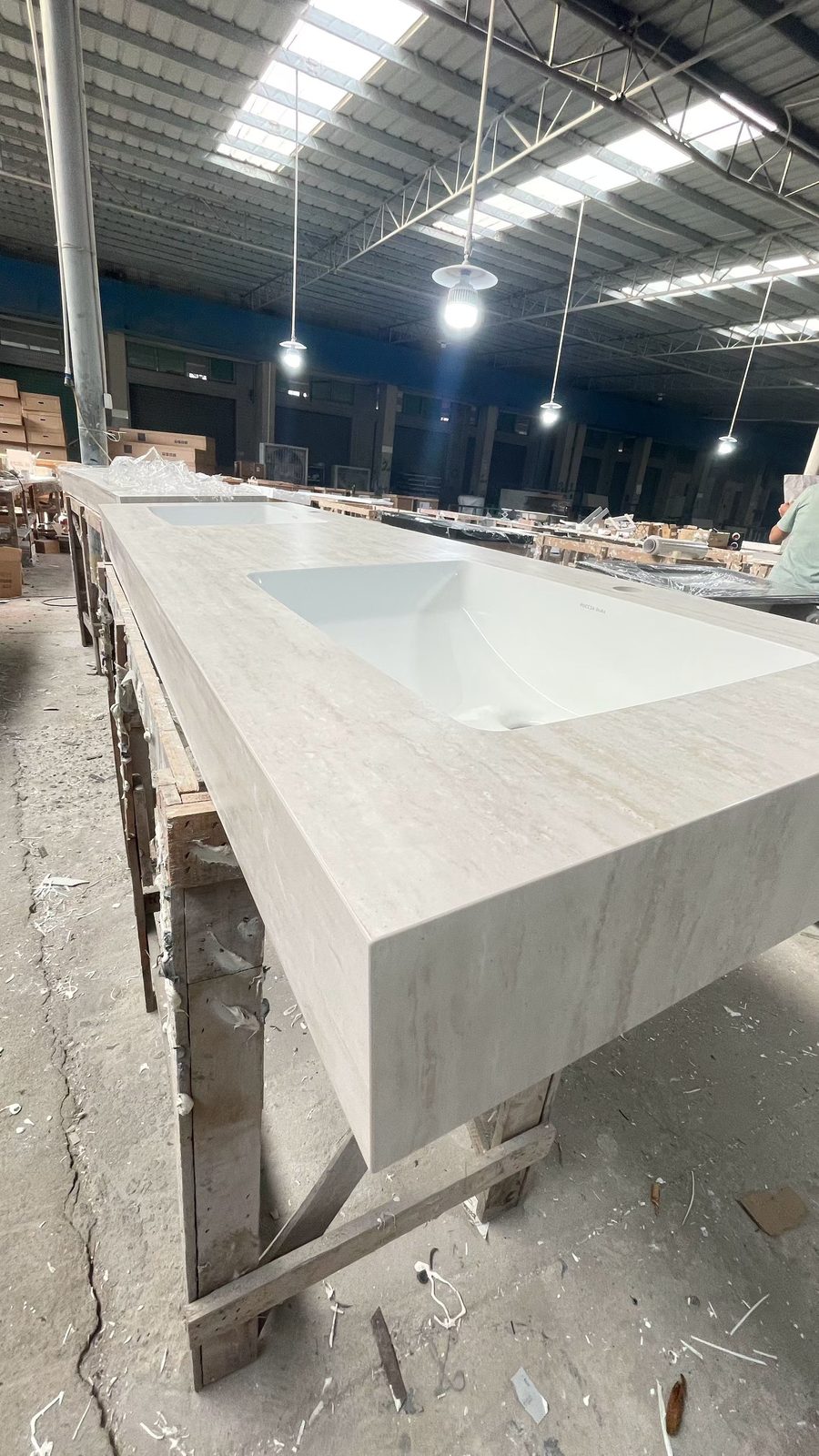
Vora Surfaces builds its vanity sets in Foshan around a solid wood cabinet body with a moisture-proof treatment, a smart LED mirror cabinet with touch control (anti-fog optional), and Kubo/DTC or equivalent-grade hardware. Locks and locking mirror-cabinet styles are buyer specification items: confirm before ordering whether the cabinet and mirror style you need can be made to your specification. Trade orders start at 10 sets with delivery in 15 working days, and sampling takes 7–20 working days depending on process complexity. See the collections and for buyers pages for styles and ordering details.
Ask about a vanity for a home with small children
If you are ordering vanities for family homes, tell us the children’s ages and which doors will hold medicines and cleaning products, and we can confirm the cabinet and mirror-cabinet styles available for your specification. Browse the product range, try the configurator, or contact us with your requirements.
Send an inquiry through our contact page and a member of the Vora Surfaces team replies to your message. Your details are used only for this inquiry. We share them with no one else and send no follow-up mailings.
Frequently asked questions
Which type of child lock works for a bathroom vanity?
No single type fits every cabinet. Adhesive locks fit light doors and rented homes, magnetic locks hide the catch and open with a key, and a keyed latch gives the firmest hold of the three on the door that stores medicines. The right choice depends on the door material, the fitting method, and the age of the child, so test the lock on the actual cabinet after fitting.
Should medicine be stored in a bathroom vanity?
Medicine belongs in a locked cabinet or on a high shelf, away from a child's reach. A low vanity shelf with loose bottles puts medicine where a crawling or climbing child can reach it. Keep everyday items and dangerous items on separate shelves, and follow local rules and a doctor or pharmacist's advice on medicine storage.
What should I do when my child learns to open the magnetic lock?
Treat it as expected and upgrade. Change the lock type on the medicine door, move medicines higher or out of the bathroom, or add a second lock to the same door. Re-test after every change, watching what the child can reach from a step stool, and re-check every few months as the child grows.
Where should cleaning sprays go if the cabinet has no lock yet?
Move them out of the child's reach until a lock is fitted: a high shelf, a locked cupboard elsewhere, or out of the bathroom entirely. Spray bottles sit at a child's eye level inside a vanity, and the trigger invites squeezing, so a cabinet with no lock is the wrong place to leave them.
What should I confirm before ordering a vanity for a home with small children?
Confirm which doors get locks, whether the door material suits the lock fitting method, and whether a locking mirror-cabinet style is available as a buyer specification before ordering. Check the doors, hinges, and lock mounting points when the vanity arrives, and test every lock with the cabinet in place.
Sourcing hot-bent basins for your next project?
Send your drawings and target quantities — we'll confirm feasibility from the factory floor.
Configure your inquirySee the products behind these guides: production cabinet styles and buying terms for buyers & OEM.
Specifications verified against Vora Surfaces factory records. Editorial review applied. Spotted an error? Email corrections to vorasurfaces@gmail.com.