
Factory guide
The Honest Maintenance Reality of Integrated Basins: What One Owner Wishes She'd Known
An integrated basin asks for a routine: a weekly wipe-down and a deep clean every two weeks. The walls feel slippery, a flat bottom holds dirt, mould gathers at the drain, and repairs are harder than on a vessel basin. Three trace to choices made before ordering — shape, drain, finish. The fourth is the price of the one-piece format.
By Vora Surfaces Factory Editorial Team · Published 2026-11-06 · Foshan, China
What one owner actually found
The clearest account of integrated basin maintenance comes from a Singapore homeowner, @adventures8home, who reviewed her integrated sintered stone basin on 30 May 2026. Her designer had warned her it is not as easy to maintain as it looks, and a month of daily use proved the warning fair. She still likes the basin and says she would choose it again — with her eyes open, and with a routine she did not expect to need.
Her review names four complaints: slippery basin walls; a flat bottom that does not carry dirt away; mould and soap scum around the drain and in the corners after about a month without a deep clean; and damage that is harder to repair than on a vessel basin, because countertop and basin are one piece. None of the four rules the format out. Each one is a design detail to check before ordering, or a habit to build after installation. This guide takes them in turn.
Why do the basin walls feel slippery?
The slippery feeling comes from the basin’s smooth, continuous surface meeting water and soap. An integrated basin has no rim joint or separate bowl edge to break the surface, so a wet hand slides across a long, unbroken curve.
Finish choice sets how strong that feeling is. A polished surface can feel slicker under soapy water than a matte one. Ask to touch a sample basin with wet hands before ordering, and run water over it rather than judging it dry.
Why doesn’t a flat basin bottom carry dirt away?
Water moves dirt only where it flows. On a flat basin bottom, water spreads, slows, and stops, leaving toothpaste, soap, and fine grit where it dries. A bottom shaped with a fall toward the drain keeps water moving in one direction, and the dirt moves with it.
This is the single most useful thing to check before ordering. Ask the supplier how the basin bottom is shaped and where the drain sits relative to the lowest point. A drain placed at the true low point, with the bottom falling toward it from every side, drains instead of standing and leaves little behind. A drain placed off-centre, or a bottom that is flat across most of its area, leaves standing water in the corners no matter how carefully you rinse.
Why does mould appear around the drain and in the corners?
Mould and soap scum need three things: moisture, residue, and time. The drain area and the corners supply all three. Water stands longest there, soap collects there, and a wipe that skims the centre of the basin misses both spots. After about a month without a deep clean, the Singapore owner found mould and soap scum in exactly those places.
A weekly wipe-down covers the whole basin, including the corners and the ring around the drain, and a deep clean every two weeks deals with the film a weekly wipe leaves behind. That is the schedule the owner settled on: mould arrives after weeks of standing water and residue, not overnight.
Cleaning method matters as much as schedule. A sintered stone basin cleans with warm water, mild dish soap, and a soft cloth — most marks stay on the non-porous surface, where a cloth can reach them. Pay attention to the drain cover itself: lift it and clean beneath it, since the underside is where residue hides longest.
Why is damage harder to repair on an integrated basin?
An integrated basin and its countertop are one piece, so damage to one is damage to both. A vessel basin that chips can be lifted off and replaced while the countertop stays in place. An integrated basin that cracks through the bowl leaves no separate part to swap.
Small damage still has workable options. A tiny edge chip can be rounded off and re-polished by a skilled fabricator, which hides the chip but changes the edge profile slightly. Anything deeper — a chip through the printed face layer, or any crack — has far narrower options. A crack across the basin, or damage at the drain or tap holes where stress concentrates, usually means replacing the top.
Prevention carries more weight here than on a vessel basin, because the cost of a miss is a whole top rather than one bowl. Keep hard bottles away from the rim, do not knock tools against the basin edge during later trades, and keep edge protectors on until the room is complete. Check the basin at delivery, before signing: a cracked arrival should be replaced rather than repaired.
How does hot-bending change the maintenance picture?
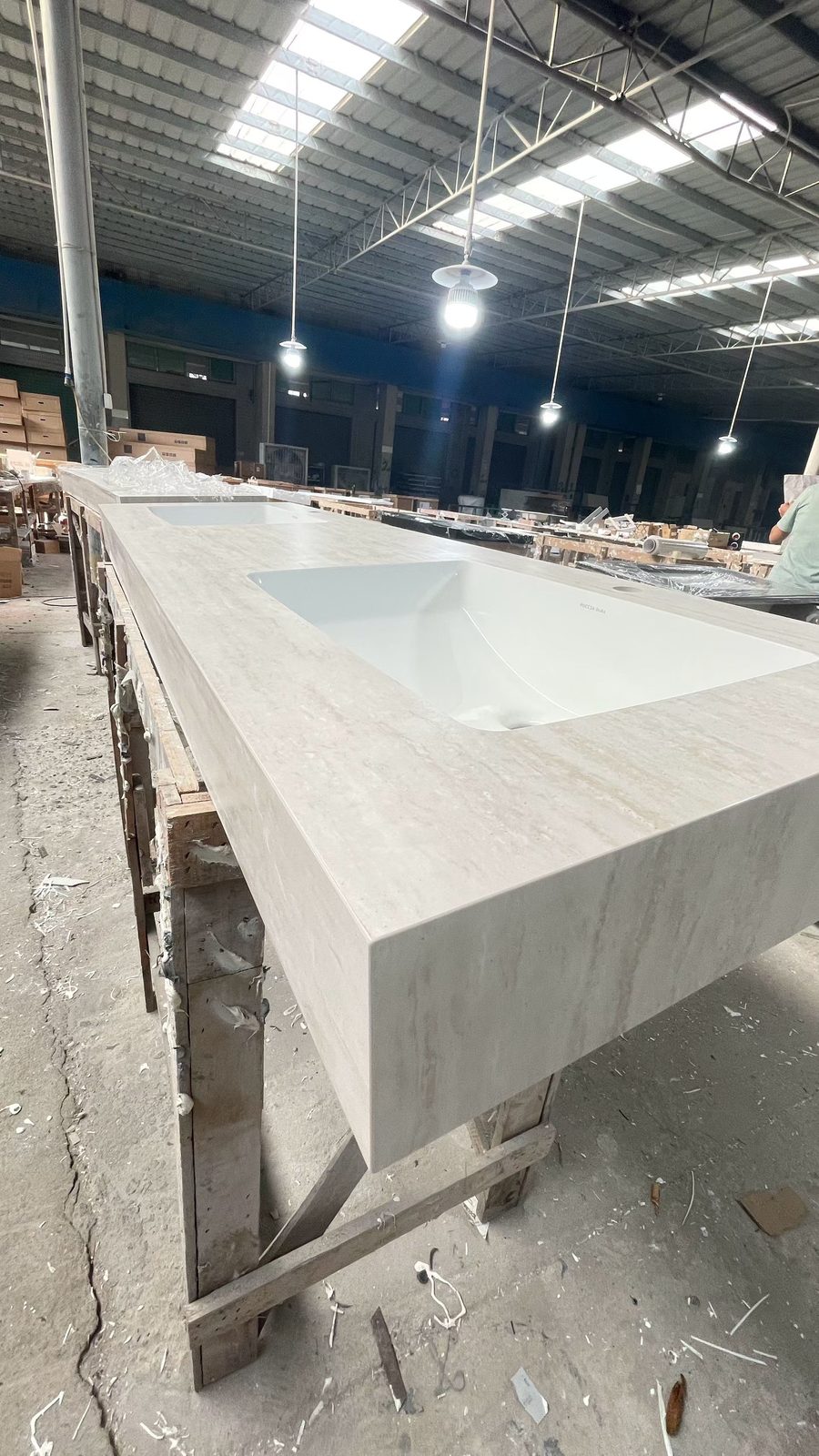
Hot-bending shapes the basin from a single slab of sintered stone: heated until pliable, bent over a mould into the basin curve, then cooled, so basin and countertop come out as one continuous piece. Vora does this hot-bending in-house at the Foshan factory, across the whole hot-bent category, in common widths of 60–120 cm. Because the basin is formed rather than assembled, there is no glued seam between bowl and countertop for soap and grime to collect in.
The forming step is also where basin-bottom shape and drain position are decided. A mould can give the bottom a fall toward the drain, so water runs off instead of standing, and the drain can be placed at the low point the mould creates. That slope is built into the basin before it leaves the factory.
The basin shape is fixed once the stone is formed, so confirm bottom shape, drain position, and tap hole layout at order time. Vora basins leave the factory with tap holes pre-drilled to mainstream mixer tap specs — confirm the hole sizing at order time. No forming method changes the fact that an integrated basin is one piece, so the repair limits above still apply. Hot-bending removes the seam problem. It does not remove the need for a weekly wipe-down.
Integrated vs vessel vs undermount: the maintenance comparison
| Format | Daily wipe | Grime traps | Mould risk spots | Repair after damage |
|---|---|---|---|---|
| Integrated (hot-bent, one piece) | One continuous surface, one pass | None at the bowl joint — no seam | Drain ring and corners if the bottom is flat | Hardest: a crack usually means replacing the top |
| Vessel (bowl on top) | Bowl plus countertop, two surfaces | Joint between bowl and countertop | Under the bowl rim and around the base seal | Easiest: replace the bowl alone |
| Undermount (bowl below the top) | Countertop plus bowl interior | Seam under the countertop edge | The undermount joint and the sealant line | In between: the joint work is fiddly |
The table shows the real trade. An integrated basin wins on daily wiping and loses on repair; a vessel basin wins on repair and loses on the joint it adds. Undermount sits between the two. The deciding question is which kind of work the household will actually do: a household that wipes weekly and deep cleans fortnightly gets the best of an integrated basin.
The weekly and fortnightly routine
| When | What to do | Time |
|---|---|---|
| Daily | Rinse the basin after use, wipe dry in hard-water areas | Under a minute |
| Weekly | Wipe the whole basin with warm water, mild dish soap, and a soft cloth; include the corners, the drain ring, and under the drain cover | Five minutes |
| Every two weeks | Deep clean: same routine, plus diluted vinegar on limescale rings and a dry-out of the drain seat | Fifteen minutes |
| Monthly | Check the tap base and drain cover for mineral crust, check edges for chips | A few minutes |
The daily rinse is the easiest step to skip. It takes under a minute and it is what keeps the weekly wipe short: residue that never dries on is residue that never needs scrubbing off.
What to check before ordering
Work through this list with the supplier before the order is cut.
- Basin bottom shape: how the bottom falls toward the drain, and whether the drain sits at the true low point.
- Drain position and type: size and type confirmed at order time, since hole positions cannot change after the stone is cut. Pop-up drains suit basins with an overflow channel; grid strainers suit ones without.
- Finish: matte or polished, chosen after touching a wet sample.
- Tap holes: count, sizing, and positions, confirmed before cutting. Vora basins are pre-drilled at the factory for mainstream mixer tap specs.
- Edges, packing, cabinet: edge finish sample, edge protectors through delivery and later trades, an edge check at delivery, foam plus wooden crate packing, and a solid wood cabinet body with moisture-proof treatment on a level frame.
- Repair terms: written terms for a cracked arrival and for a chip found after installation, agreed before ordering.
- Mirror and hardware: smart LED mirror with touch control and anti-fog optional, and Kubo/DTC or equivalent-grade hardware.
Vora factory practice: hot-bending done in-house in Foshan, common widths 60–120 cm, tap holes pre-drilled at the factory, tape-measure checks before packing, and foam plus wooden crate packing. Minimum order is 10 sets, delivery runs 15 working days, and sampling takes 7–20 working days.
Frequently asked questions
Are integrated basins hard to maintain?
They need a steady routine rather than heavy work: a weekly wipe-down and a deep clean every two weeks, in the words of one Singapore owner. The surface itself wipes clean; the work sits in the corners, around the drain, and on a flat basin bottom where water and soap can stand.
Why does mould appear around an integrated basin drain?
Standing water and soap residue feed it. A flat basin bottom that drains slowly leaves water sitting around the drain and in the corners, and after about a month without a deep clean one owner found mould and soap scum in exactly those spots. A basin bottom shaped toward the drain and a fortnightly deep clean keep it from taking hold.
Can a damaged integrated basin be repaired?
Damage is harder to repair than on a vessel basin, because the countertop and basin are one piece. A tiny edge chip can be rounded off and re-polished by a skilled fabricator, but a crack through the basin usually points to replacing the whole top.
How often should I deep clean an integrated sintered stone basin?
Every two weeks, on top of a weekly wipe-down. That is the routine the Singapore owner settled on after mould appeared at the one-month mark.
Do professionals still recommend integrated basins?
Yes. Toronto contractor ZeroForm Construction makes an integrated basin its default recommendation for everyday bathrooms unless the client has a specific design preference.
Ask about your bathroom
If the maintenance picture above still leaves an integrated basin in the running, send the details that decide fit: room size, wall, basin width, tap model, and mounting type. Tell the Vora team those details through the inquiry form so basin-bottom shape, drain position, and tap hole layout can be confirmed before cutting, or message the team on WhatsApp for a faster answer.
When you send an inquiry, it goes to the Vora Surfaces team inbox at vorasurfaces@gmail.com or through the inquiry form. It is used only to reply to this inquiry, with no mailing list and no sharing of your details. We state no response time here.
Frequently asked questions
Are integrated basins hard to maintain?
They need a steady routine rather than heavy work: a weekly wipe-down and a deep clean every two weeks, in the words of one Singapore owner. The surface itself wipes clean; the work sits in the corners, around the drain, and on a flat basin bottom where water and soap can stand.
Why does mould appear around an integrated basin drain?
Standing water and soap residue feed it. A flat basin bottom that drains slowly leaves water sitting around the drain and in the corners, and after about a month without a deep clean one owner found mould and soap scum in exactly those spots. A basin bottom shaped toward the drain and a fortnightly deep clean keep it from taking hold.
Can a damaged integrated basin be repaired?
Damage is harder to repair than on a vessel basin, because the countertop and basin are one piece. A tiny edge chip can be rounded off and re-polished by a skilled fabricator, but a crack through the basin usually points to replacing the whole top rather than patching one part of it.
How often should I deep clean an integrated sintered stone basin?
Every two weeks, on top of a weekly wipe-down. That is the routine the Singapore owner settled on after mould appeared at the one-month mark. Daily care stays simple: warm water, mild dish soap, and a soft cloth.
Do professionals still recommend integrated basins?
Yes. Toronto contractor ZeroForm Construction makes an integrated basin its default recommendation for everyday bathrooms unless the client has a specific design preference. The maintenance trade-offs are real, and professionals still stand behind the format.
Sourcing hot-bent basins for your next project?
Send your drawings and target quantities — we'll confirm feasibility from the factory floor.
Configure your inquirySee the products behind these guides: production cabinet styles and buying terms for buyers & OEM.
Specifications verified against Vora Surfaces factory records. Editorial review applied. Spotted an error? Email corrections to vorasurfaces@gmail.com.