
Factory guide
How Bathroom Vanities Are Packed for International Shipping
For international shipping, bathroom vanities are packed by wrapping the stone basin in protective foam and crating it in a wooden export crate with internal wooden framing and strapping to hold the load rigid. Before packing, each basin top is checked with a tape measure against its spec, and finished crates are stacked in the warehouse awaiting container loading. This foam-plus-crate approach is designed to protect a rigid, brittle stone piece through the shocks and vibration of a long overseas voyage.
By Vora Surfaces Factory Editorial Team · Published 2026-10-11 · Foshan, China
Buyers usually search “how are bathroom vanities packed for international shipping” because they have seen the other side of the transaction. Amazon’s aggregated reviews put “damage upon arrival” at 6.8% of negative feedback for stone vanities, and A Wayfair review describes a stone top arriving “cracked all the way across,” and a buyer complaint logged on gethuman reports two consecutive broken deliveries with construction plans on hold. This guide shows the factory side: our own packing line in Foshan, with real photos of the crates, the foam, and the tape-measure checks that happen before anything is sealed.
Our packing line, step by step
Most international vanity orders travel by sea freight — a weeks-long journey of container handling, stacking, and road vibration at both ends (general industry context; the packing below is what we do in Foshan for every export order). Here is the sequence.
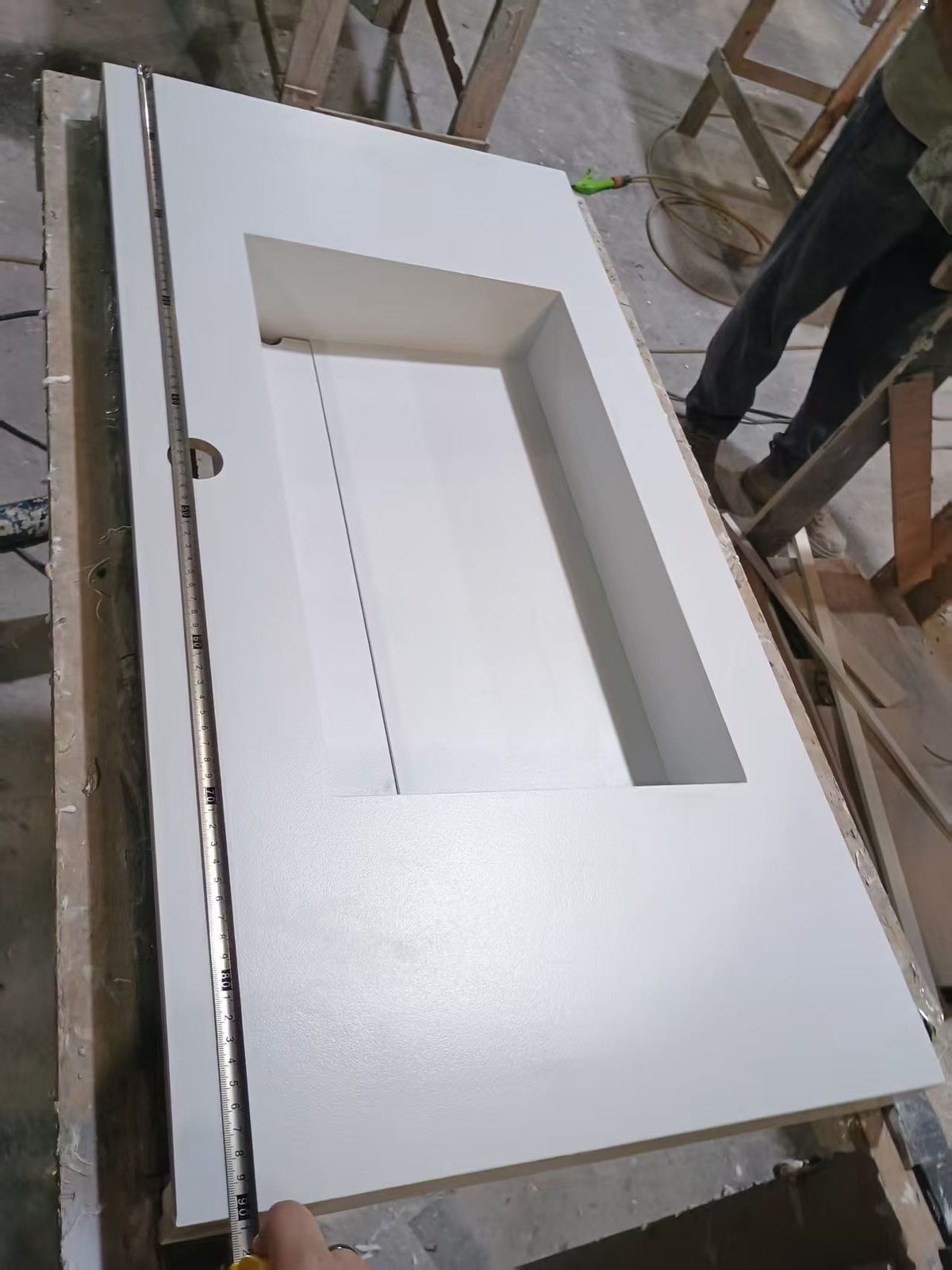
Step 1: tape-measure check before anything is wrapped. Each basin top is checked with a tape measure against the order spec before anything is wrapped. A unit that fails this check never reaches the foam.
Step 2: protective foam wrap. The basin is wrapped in protective foam. The foam layer does two jobs: it cushions the surface against abrasion, and it pads the corners and edges — the zones most likely to chip. The wrap goes on snug, because loose foam bunches up and leaves corners exposed.
Step 3: into a wooden crate with internal framing. The foam-wrapped basin goes into a wooden export crate built with internal wooden framing. The frame is the structural heart of the package: timber members around the unit hold it in a fixed position, so the basin cannot slide side to side or forward and back inside the crate. In the photo you can see the open crate — the timber frame around the foam cocoon, the white basin just visible through the wrap.
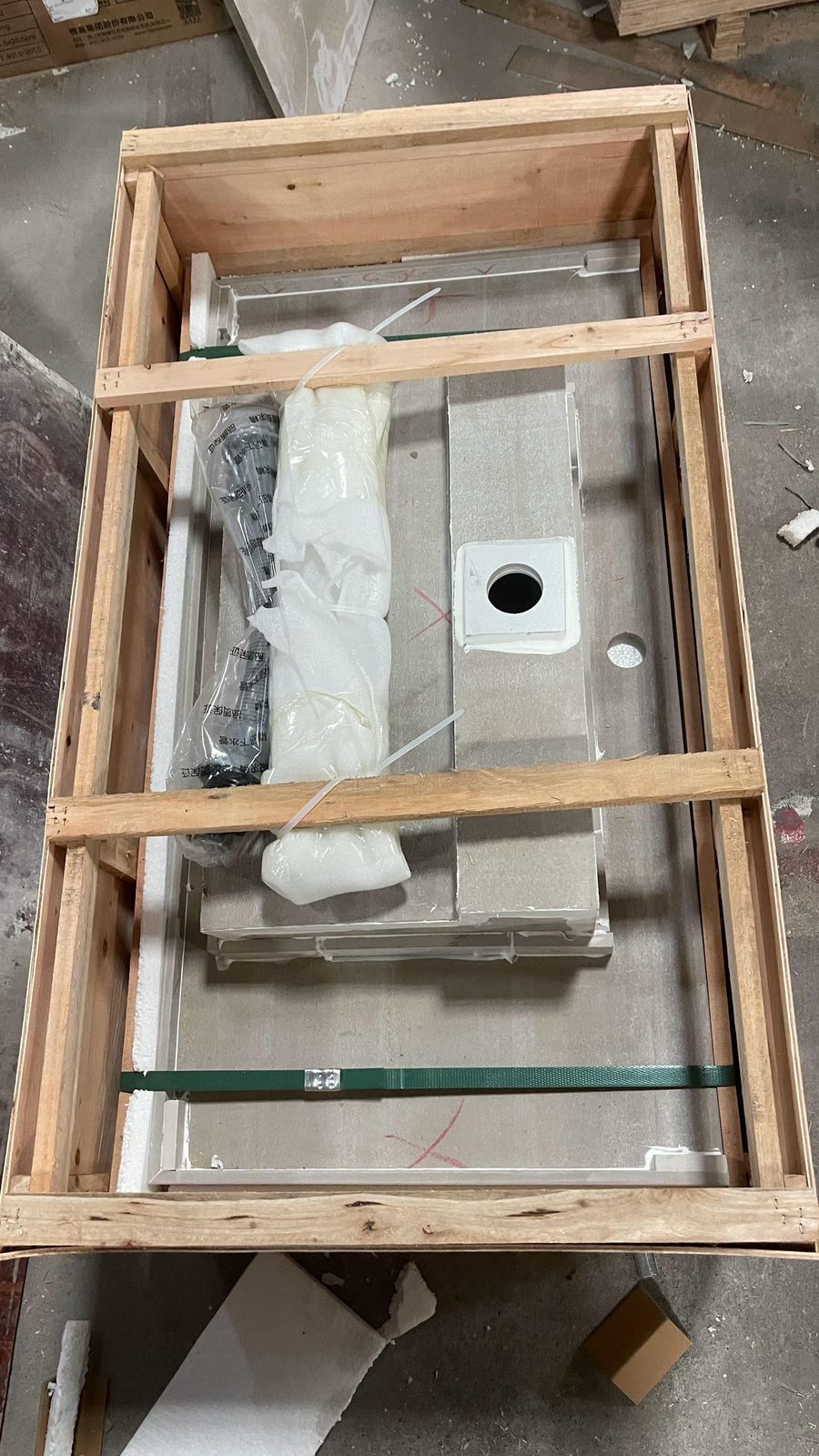
Step 4: strapping. Straps run over the foam-wrapped basin and cinch it down against the internal frame. Strapping handles the vertical axis: without it, a heavy stone piece can bounce within the crate on rough roads, and each bounce lands on the frame. With it, the basin, foam, and frame move as one unit.
Step 5: warehouse staging. Finished crates are stacked in the warehouse, ready for container loading. Crates are stacked in stable configurations so they do not topple during loading, and the wooden crate — not the stone inside — takes the contact with neighboring cargo.
What the factory photos show that words cannot
The un-Googleable detail in the two photos above is worth slowing down for, because this is the part of the process buyers almost never get to see.
In the crate photo, look at the timber: internal wooden members run around the basin, dividing the interior into a tight pocket. The foam wrapping is visible as a pale cocoon around the white basin — thicker at the corners, where the padding is deliberately built up. The strapping crosses over the top of the wrap, pulling the whole assembly down onto the frame. What leaves the warehouse is a single rigid package: wood, foam, and stone locked together, with nothing inside free to move.
In the QC photo, a steel tape measure is pulled taut across the top of a basin on the packing workbench — the same bench where the foam goes on minutes later. That ordering matters: measure first, wrap second.
Why the corners and edges get the extra attention
Sintered stone’s weak point is documented by people who sell the stuff, not just people who make it. Hunker describes the material as “prone to chipping and cracking along the edges,” and a sintered stone distributor put the mechanism in plain language: a sharp, concentrated impact can chip the surface or crack it, while a stone-restoration handbook notes that repairs can be limited. Buyers know this in their gut — one Wayfair reviewer wrote, “I did have fears of corner damage or crack, but it came perfect… arrived incredibly well packaged.” The anxiety is the norm; the relief is the exception that proves the packing worked.
That is why the crate’s framing and foam concentrate on the perimeter. The internal frame keeps the stone from ever meeting the crate walls, and the padded corners mean that when the crate takes a hit — and crates take hits — the force lands on foam and timber, away from the bare stone edge. This is designed to reduce the most common category of transit damage: protection sized in timber and foam to the material’s real weakness.
Does the basin travel with the cabinet, or separately?
This is the question behind a large share of buyer complaints. Amazon’s aggregated reviews put “difficult assembly” at 31.1% of negative feedback for stone vanities — the single largest complaint category. Some of that traces back to how the pieces traveled: a basin and cabinet that ship in separate packages with no assembly plan arrive as a puzzle.
What we can say from our own line: the stone basin travels in its own foam-and-crate package — the framing is sized to the stone piece, and that is the unit our packing photos document. The basin itself arrives as one continuous hot-bent piece with tap holes pre-drilled at the factory for mainstream mixer specs (confirm hole sizing with us at order time), so the stone work on site stays minimal. Solid wood has a strong reputation in bathrooms, and in practice the reputation mostly holds — with treatment doing the heavy lifting. Our cabinet bodies are solid wood with moisture-proof treatment, and our production cabinet styles are listed in the cabinet collection.
If you order a full vanity set — basin, cabinet, mirror — ask the factory how the pieces ship together before production starts: one crate or several, and what assembly happens on site versus in the factory. Get that answer in writing alongside the price. The packing protects the pieces; only the plan protects the schedule.
From the warehouse stack to your door
Finished crates leave the warehouse stacked and strapped for container loading. At the destination end, the routine that matters most happens in the first five minutes: stone vanities crack in transit far more often than they crack in use. Open the crate, inspect the stone before signing, and check the route the crate traveled through your building as well as the room it ends up in — measure the route as well as the room — narrowest doorway and tightest turn, with the unit in its crate.
Two buyer-side checks worth adding to your own list. First, inspect corners, edges, the tap deck, and pre-drilled holes before you sign the delivery note; run a hand along every edge and photograph anything suspicious. Second, ask about the export wood treatment for your destination: many countries require wooden packaging to meet ISPM 15 phytosanitary rules (heat treatment with a stamped mark), and requirements vary by destination — this is a general industry note, so confirm it with your supplier for your route.
Honest limits: what packing can and cannot do
A word about what this article does not claim. No combination of foam, framing, and strapping makes transit damage impossible. Sintered stone is a rigid, brittle sheet; a container that drops, a forklift tine that finds the wrong spot, a transshipment port in a hurry — the packing is designed to reduce the odds on a long voyage. We describe what we do on the packing line, and we show it in photos. We do not promise zero damage, because no factory that ships real stone across an ocean honestly can.
What the packing does change is where failures concentrate and how often they happen: movement inside the crate is the preventable category, and the frame-plus-strapping combination exists to take that category off the table. If a unit still arrives cracked despite the crate — it happens — the correct response is the one experienced buyers settled on long ago: refuse it on delivery, do not install it “temporarily,” document everything with the crate open, and demand a replacement unit with photo or video proof before it ships. An installed crack becomes your crack.
Frequently asked questions
What should I do if my vanity arrives damaged?
Refuse it on delivery and do not let it be installed. Photograph the damage with the crate still open, then ask the supplier for a replacement unit — the stone trade treats repair as a discount-tier outcome, not a like-new one.
Does the basin ship in the same crate as the cabinet, or separately?
The stone basin travels in its own foam-and-crate package, sized to the stone piece. How a full set travels — basin, cabinet, mirror — varies by order and by factory, so confirm it with your supplier before production and get the assembly plan in writing.
What should I check at delivery before signing?
Open the crate and look at the stone before you sign: corners and edges first, then the tap deck, the basin bowl, and any pre-drilled holes. Run a hand along the edges for chips and photograph anything suspicious.
Are the corners and edges given extra protection?
They get the most attention in the crate — edges and corners are where sintered stone is most vulnerable, so the internal wooden framing and foam are arranged to hold the stone rigid at those points.
Can I ask for photos or a video of my unit before it ships?
Yes, and you should. Each of our basin tops gets a tape-measure check against its spec before packing — asking the factory to share that check, or a short video of the crated unit, is standard due diligence.
Why does the crate need internal wooden framing — is foam wrapping not enough?
Foam cushions; framing stops movement. A heavy slab that can slide inside its crate builds momentum with every bump and transfers that force into the stone. The frame holds the foam-wrapped basin in place and the strapping holds it down, so the unit cannot shift during the voyage.
Sourcing hot-bent vanities for a project? Browse the hot-bent range — around 40 models in 60–120 cm, hot-bent in-house in our Foshan factory — or configure your spec and request a quote. The production cabinet styles are in the cabinet collection, and you can see the real packing photos in the From the floor gallery.
When you send an inquiry, it goes to the Vora Surfaces factory team in Foshan — a real person who answers questions about your specific project. Your details are used for that inquiry only: no mailing list, no bulk follow-ups.
Specifications verified against Vora Surfaces factory records. Editorial review applied. Spotted an error? Email corrections to vorasurfaces@gmail.com.
Frequently asked questions
What should I do if my vanity arrives damaged?
Refuse it on delivery and do not let it be installed — an installed crack becomes your crack. Photograph the damage while the crate is still open, then ask the supplier for a replacement unit. The stone trade treats repair as a discount-tier outcome: a fabricator in a long-running r/CounterTops thread put the compensation for accepted repair work at 'maybe 10%' off, and experienced buyers on r/askSingapore consistently say to demand a replacement and ask for photo or video proof of the new unit before it ships.
Does the basin ship in the same crate as the cabinet, or separately?
The stone basin travels in its own foam-and-crate package: protective foam, a wooden crate with internal wooden framing and strapping, sized to the stone piece. How a full set travels — basin, cabinet, mirror — varies by order and by factory, so confirm it with your supplier before production: one crate or several, and how much assembly happens on site. Assembly is a real buyer complaint — 'difficult assembly' accounts for 31.1% of negative Amazon reviews for stone vanities — so get the packing and assembly plan in writing.
What should I check at delivery before signing?
Open the crate and look at the stone before you sign: corners and edges first, then the tap deck, the basin bowl, and any pre-drilled holes. Run a hand along the edges for chips and photograph anything suspicious. Stone vanities crack in transit far more often than they crack in use, so this five-minute check is the highest-leverage moment of the whole delivery. Our installation guide's delivery-inspection walkthrough covers the full routine.
Are the corners and edges given extra protection?
They get the most attention in the crate. Edges and corners are where sintered stone is most vulnerable — Hunker describes the material as 'prone to chipping and cracking along the edges' — so the internal wooden framing and foam are arranged to hold the stone rigid at those points. The method is designed to reduce movement and impact where the material is weakest.
Can I ask for photos or a video of my unit before it ships?
Yes, and you should. Before packing, each of our basin tops gets a tape-measure check against its spec — and asking the factory to share that check, or a short video of the crated unit, is standard due diligence. Suppliers who agree quickly are showing you their process; suppliers who resist are telling you something. Buyers in stone forums recommend exactly this: 'Demand complete replacement, and ask for video proof.'
Why does the crate need internal wooden framing — is foam wrapping not enough?
Foam cushions; framing stops movement. Sintered stone is rigid and brittle, so a heavy slab that can slide inside its crate builds momentum with every bump and transfers that force into the stone. The internal wooden frame holds the foam-wrapped basin in place and the strapping holds it down — together they keep the unit from shifting through the shocks and vibration of a long voyage. The two do different jobs — foam cushions, the wooden frame holds the unit still — and a heavy stone piece needs both.
Sourcing hot-bent basins for your next project?
Send your drawings and target quantities — we'll confirm feasibility from the factory floor.
Configure your inquirySee the products behind these guides: production cabinet styles and buying terms for buyers & OEM.
Specifications verified against Vora Surfaces factory records. Editorial review applied. Spotted an error? Email corrections to vorasurfaces@gmail.com.