
Factory guide
Can Sintered Stone Be Bent? Hot Bending, Its Limits & How to Verify
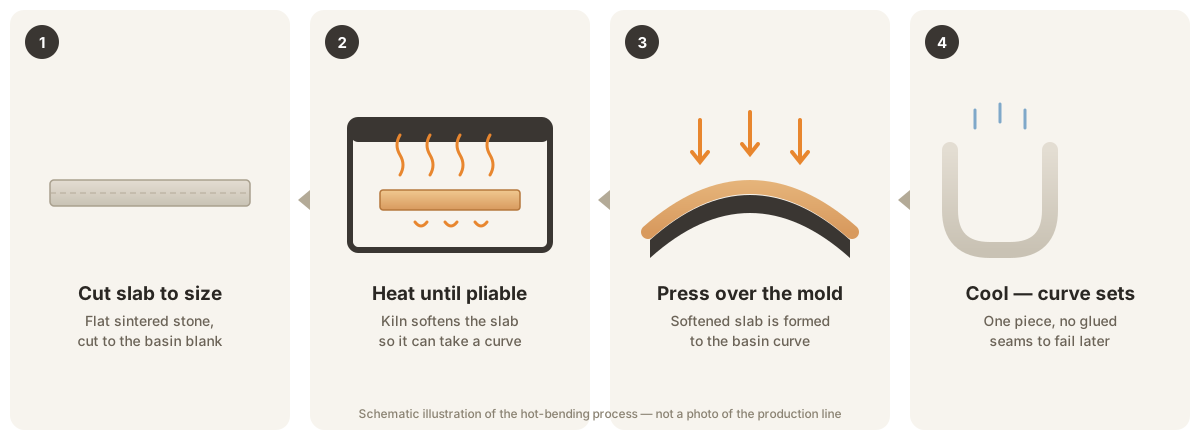
Yes. Sintered stone can be bent, but only with heat. In hot bending (thermoforming), a flat slab is heated until pliable, formed over a mold, then cooled so the curve sets permanently — one continuous piece of stone, no glued seam at the bend.
By Vora Surfaces Factory Editorial Team · Published 2026-10-02 · Foshan, China
This is the question Google’s own “People also ask” box poses verbatim — and most answers online either dodge it or bury it under marketing copy. Here is the straight version, from a factory that does its own bending: what the process is, where its limits sit, and how to tell a genuinely bent basin from a glued one wearing the label.
How bending a stone actually works
Sintered stone starts life as mineral particles pressed under high pressure and kiln-fired until they fuse into a dense, non-porous slab. (We explain the material itself in what a sintered stone basin is.) Once fired, that slab is rigid — you cannot cold-bend it any more than you can cold-bend a floor tile. Heat is the only thing that makes it move.
Hot bending runs in five steps. The sequence below describes standard industry practice; kiln designs and cooling schedules vary from shop to shop.
1. Cut the blank. The factory checks a slab for color consistency and surface defects, then cuts a blank sized for the basin mold.
2. Heat evenly. The blank goes into a bending kiln and is heated across its full surface until pliable. Evenness matters more than peak temperature: a cold spot in the blank becomes a stress point in the finished basin. This is the step that separates an equipped factory from a workshop with a saw and a tube of adhesive.
3. Form over the mold. While pliable, the blank is laid over a mold and shaped into the basin profile — bowl, apron, and tap deck — in one continuous motion. The mold defines the geometry, so every basin from the same mold carries the same curve.
4. Cool on the mold. The formed piece rests on the mold while it cools, locking the curve and preventing warp as the slab stiffens. Basins that rock on a flat counter usually trace back to this step being rushed.
5. Trim and finish. Once set, the basin is trimmed to its final outline and the exposed edges are finished. Because the body is one piece, there are no joint edges to grind flush — the work is about finish, not hiding seams.
For the full walkthrough with honest trade-offs and a bent-vs-glued comparison table, see our hot-bent sintered stone basin guide.
What hot bending can and can’t do
The process is powerful within its envelope and useless outside it. Knowing the boundary saves you from ordering a shape no bending line can produce.
Continuous curves: yes. Basin bowls, curved aprons, swept tap decks — any smooth, unbroken radius is the home turf of hot bending. The curve is the slab itself, so it cleans with one wipe and carries no joint to age.
Gentle S-curves and wide radii: usually yes. These depend on the mold. An existing mold means the shape is proven and repeatable; a new profile means tooling a new mold first.
Sharp 90° folded edges: no. A crisp crease is not a bend — folding a slab to a knife edge would fracture it. Sharp architectural geometry belongs to mitered, glued construction, where flat pieces meet at 45° with adhesive. If your design drawing shows razor corners, bending is the wrong process and an honest factory will tell you so. Our hot-bent vs glued decision guide walks through when each construction wins.
Very tight radii in thick slabs: limited. Geometry, slab thickness, and blank size bound what is feasible, and the limits move with all three at once. Industry spec charts list slabs up to 1600×2800 mm in 6–12 mm thicknesses; what a given factory can bend within that envelope depends on its kiln and molds. Treat any sharp-cornered “bent” claim with skepticism and ask how the radius was formed.
Custom one-off curves: possible, with tooling. Each new profile needs its own mold, quoted separately with added time before production. Settle the mold question before falling in love with a drawing — adapting an existing mold is faster and cheaper than tooling from scratch. The practical next step is unglamorous: send the factory your drawings with target widths and quantities, get a yes-or-no on feasibility against existing tooling, and only then lock the design. A five-minute feasibility check now beats a redraw later.
| Shape | Hot bending? |
|---|---|
| Smooth continuous curves (bowls, aprons, tap decks) | Yes — the process’s home turf |
| Gentle S-curves, wide radii | Yes, mold-dependent |
| Sharp 90° folded edges | No — that’s mitered and glued territory |
| Tight small-radius bends | Limited — geometry, thickness, and slab size bound it |
| Brand-new custom profiles | Possible — needs new mold tooling first |
Bent vs glued at a glance
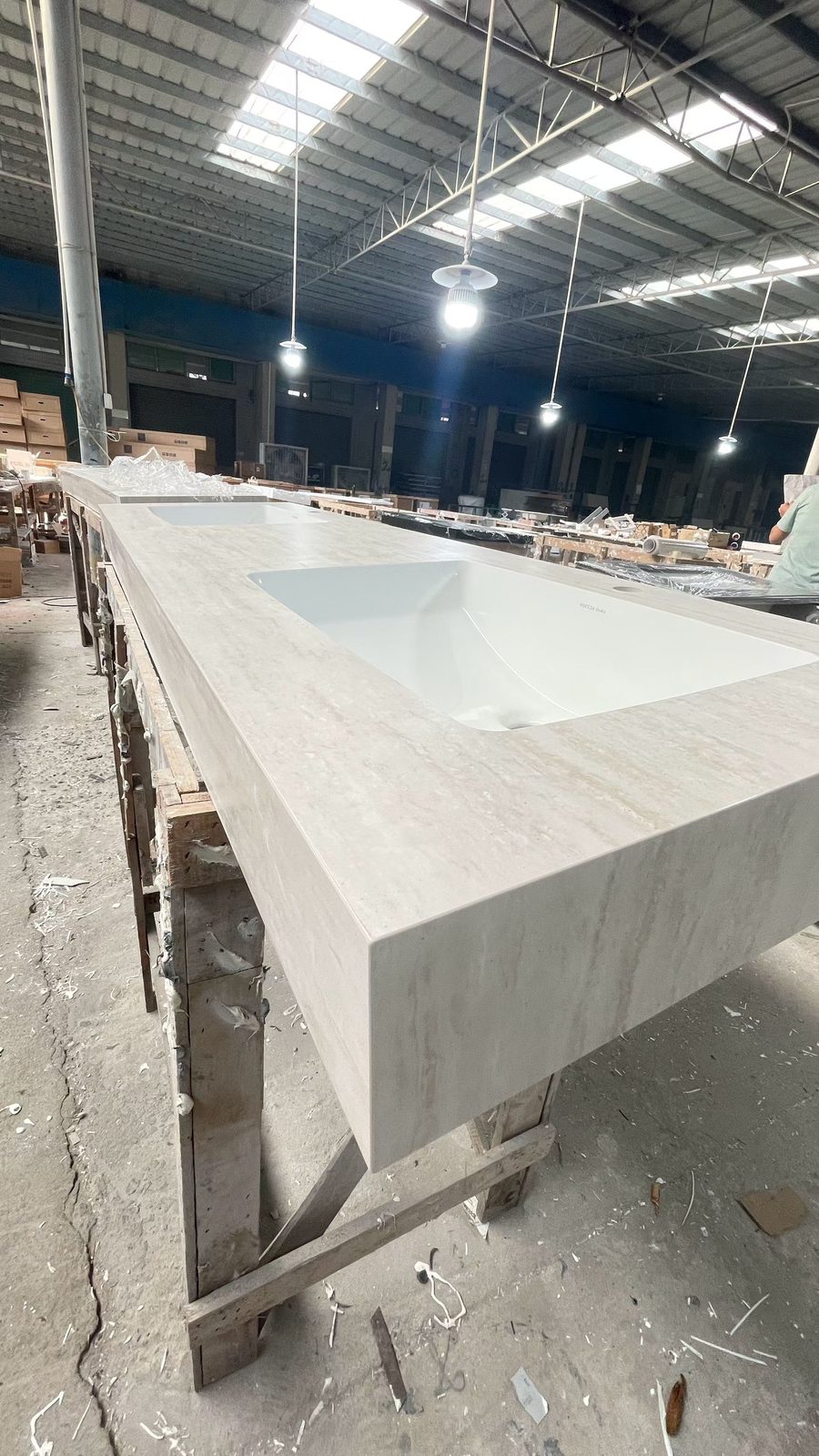
Before the comparison: one habit separates experienced buyers from first-timers. They ask for the bend photo — a close-up of the curve, inside and out. A genuine hot-bent basin shows a smooth, continuous radius with the slab’s pattern flowing unbroken around it. A glued basin shows a joint line, however neatly finished. Suppliers with a real bending line send that photo without hesitation; suppliers who hedge usually have something to hide.
Most “sintered stone basins” on the market are assembled, not bent: flat pieces cut, mitered at 45°, and glued into shape. The table shows what changes when the bend is real.
| Hot-bent | Glued / 45° mitered | |
|---|---|---|
| Bend construction | One continuous slab | Pieces joined with adhesive |
| Seam at the bend | None | Glued joint line |
| Dirt trap | No crevice | Joint collects grime |
| Glue aging | No adhesive in the bend | Adhesive yellows and weakens over time |
| Curve geometry | Smooth, continuous radius | Angled, faceted profile |
| Equipment needed | Kiln + molds + skilled operators | Saw + adhesive |
| Unit cost | Higher | Lower |
How to tell a real hot-bent basin from a glued one
Some listings borrow the word “hot-bent” for glued basins. Four checks separate the real thing from the label.
1. Ask the direct question. “Is the basin bent from a single slab, or assembled from glued pieces?” A straight answer ends the discussion. Evasion is itself an answer.
2. Read the curve. A bent radius is smooth and continuous; you can run a finger along it without feeling a transition. A mitered basin shows faceted angles on close inspection, however well the joint is finished.
3. Ask for process evidence. Request a photo of the bend from underneath, or a short clip of the bending step. A factory that actually hot-bends shows its line without hesitation — at Vora Surfaces the bending is done in-house at our Foshan factory, not outsourced, which is exactly why we can show it.
4. Ask what is already tooled. Existing molds mean the curve is proven, sampling is fast, and there is no tooling charge. A supplier that cannot name its tooled profiles probably does not bend.
Sourcing genuinely hot-bent basins? Vora Surfaces bends every basin in-house at our Foshan factory — around 40 catalog models in 600–1200 mm widths, plus custom profiles across the hot-bent category. Browse the product range or send your drawings through the contact page for a feasibility check and quote.
Frequently asked questions
Can sintered stone be bent?
Yes — but only with heat. In hot bending (thermoforming), a flat slab is heated until pliable, formed over a mold, then cooled so the curve sets permanently. Cold bending is not possible; the stone only moves under heat.
Can I bend sintered stone myself or on site?
No. Bending needs a kiln that heats the full blank evenly plus a mold for the target profile — industrial equipment, not site tools. If you need a curved basin, order the shape from a factory that hot-bends in-house.
Does heating weaken sintered stone?
Even heating does not. The whole blank turns pliable at the same rate and cools under control on the mold. Problems come from uneven heating, which leaves stress points — that is a kiln and operator issue, not a material flaw.
Why did my sintered stone basin crack if the material is so hard?
Hardness resists scratches, not bad support. The usual causes are uneven cabinet bedding that lets the top flex around cutouts and corners, or a glued joint giving way — not the bent stone itself. Both trace back to installation quality or construction method, which is why experienced installers matter more than the basin's spec sheet.
Can a bent basin be repaired if it chips?
Barely. A fabricator can sometimes round and re-polish a small edge chip, but sintered stone patterns are printed on the surface — a deep chip exposes the base body color underneath, and no field repair restores the original face. Treat edges as permanent and protect them in transit and installation.
How do I verify a supplier really hot-bends instead of gluing?
Ask one direct question: is the basin bent from a single slab, or assembled from glued pieces? Then ask for evidence — a photo of the bend from underneath or a short clip of the bending step. A factory that actually hot-bends shows its line without hesitation.
Sourcing hot-bent basins for your next project?
Send your drawings and target quantities — we'll confirm feasibility from the factory floor.
Configure your inquirySpecifications verified against Vora Surfaces factory records. Editorial review applied.