
Factory guide
Bathroom Vanity QC Checklist: 12 Inspection Points Before You Accept Delivery
A bathroom vanity quality inspection is a structured check of a vanity order before acceptance: twelve points across the basin, cabinet body, hardware, mirror, finish, and packing, each with a pass standard agreed in writing. It takes about thirty minutes per unit — a fault found at delivery costs a phone call; one found after installation costs a replacement and a delayed project.
By Vora Surfaces Factory Editorial Team · Published 2026-11-10 · Foshan, China
In short: A bathroom vanity QC inspection covers twelve checks across the basin, cabinet body, hardware, mirror, finish, and packing. Measure the basin against the order sheet, test every drawer and door, light the mirror, and inspect the crate before signing. Photograph any fault and note it on the delivery paperwork.
Why inspect before you accept
Damage on arrival is a documented complaint: Amazon’s aggregated reviews put it at 6.8% of negative feedback for stone vanities. A Wayfair reviewer in Hamburg, Pennsylvania, wrote: “the first one arrived cracked all the way across.” Hardware complaints run higher still: “poor lock mechanisms” account for 24.3% of negative feedback, and “difficult assembly” for 31.1%.
Buyers also ask who pays when a unit arrives cracked and what counts as fixed. A fabricator in a long-running r/CounterTops thread put it plainly: “repairs are a normal part of fabrication… they should give you some money off. Maybe 10%.” This checklist gives you dated photos and written pass standards, so the negotiation starts from evidence.
How to run the twelve checks
Set aside thirty minutes per unit, a tape measure, a flashlight, a charged phone, the order sheet, and the packing list. Work in order — crate, stone, cabinet, hardware, mirror, finish, paperwork. Photograph everything, passes included, and write any fault on the delivery paperwork before signing.
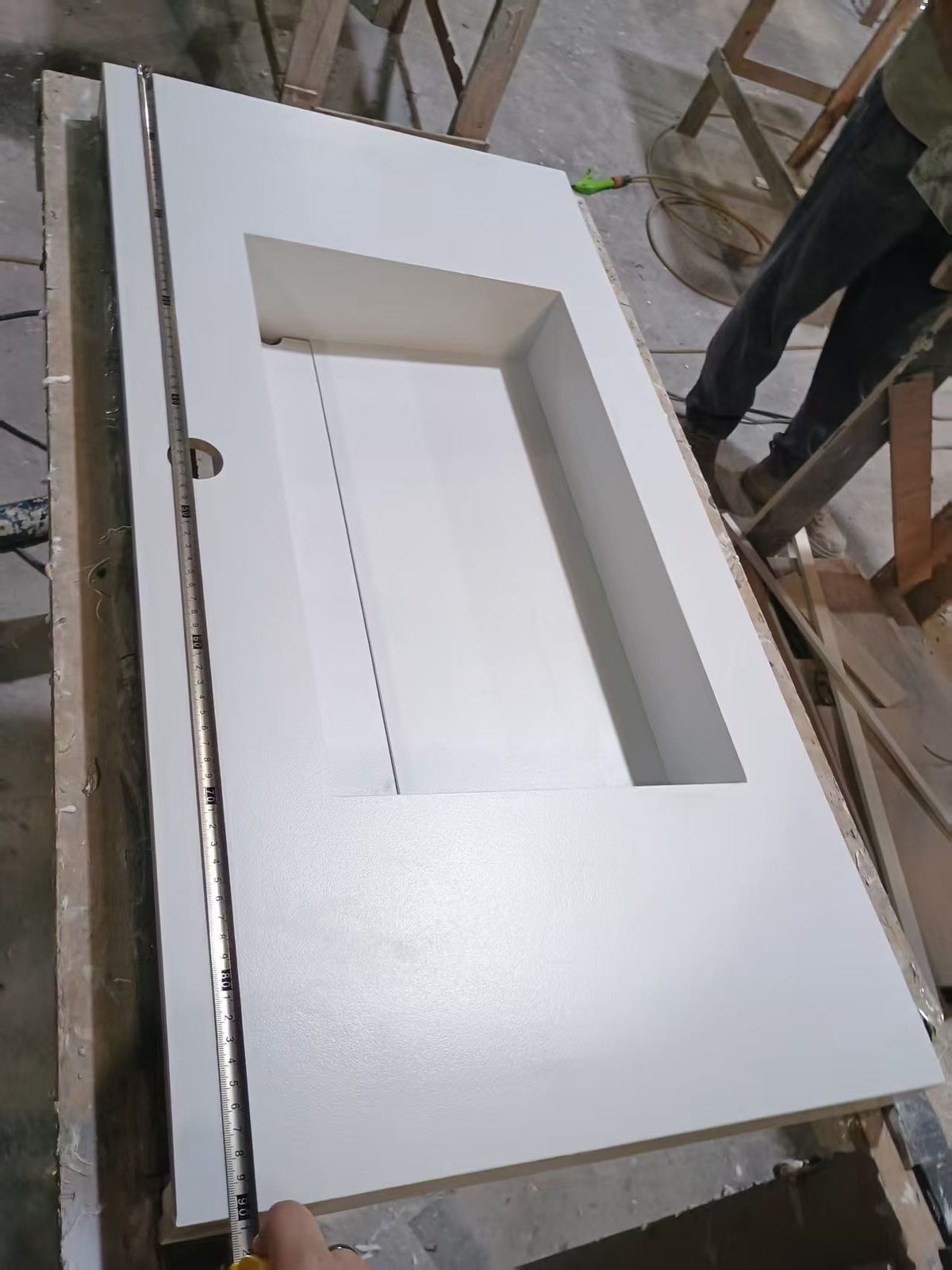
The basin: points 1–3
Point 1 — Dimensions against the order sheet. Measure the basin top width, depth, and height against the order sheet. Common vanity widths run 60–120 cm. Pass: every measured figure matches the order sheet.
Point 2 — Basin bowl and tap deck under raking light. Lay the top flat and shine the flashlight at a low angle: raking light shows hairline cracks overhead light hides. Run a fingertip along every edge and the basin curve, looking for cracks radiating from the tap holes and chips at the rims. Pass: no cracks, chips, or flakes at any edge, cutout, or rim. Any crack across the basin is a fail (see the FAQ on the “10% rule”).
Point 3 — Tap holes: count, position, and size. Count the tap holes and check positions against the order sheet and the tap spec. At Vora, hot-bent sintered stone basins are pre-drilled for tap holes at the factory, and mainstream mixer tap specs are supported. Pass: hole count and positions match the order, and the holes fit the tap spec.
The cabinet body: points 4–6
Point 4 — Cabinet square and level. Stand the cabinet on a flat floor, check it with a level both ways, and measure the two diagonals across the front: equal diagonals mean a square frame. Pass: level both ways, matching diagonals, even door and drawer gaps. As our guide explains, “A stone vanity top cracks when installation concentrates load on one weak point” — and an out-of-square cabinet concentrates it.
Point 5 — Cabinet body moisture package. Ask for the cabinet construction spec in writing and check the body against it. Vora cabinet bodies are solid wood with moisture-proof treatment. Check panel edges, the underside, and the back panel for swelling, soft spots, or unfinished surfaces. Pass: body matches the order spec, edges sealed, no swelling or softening.
Point 6 — Drawer depth and the plumbing cutout. Open every drawer fully and check the usable depth left once the drain and trap are accounted for. Buyers in video comment threads put it this way: a wide drawer front that opens onto “a skinny little, narrow shallow apology for a drawer.” Pass: each drawer clears the drain and trap with room to spare, and usable depth matches the order drawing.
The hardware: points 7–8
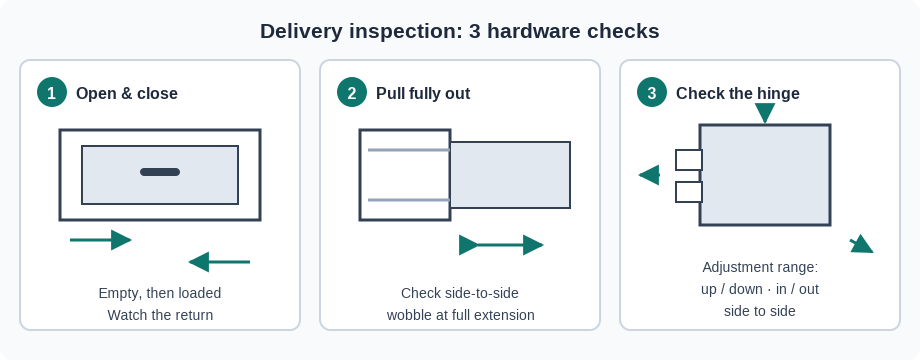
Point 7 — Slides and hinges in motion. Open and close every drawer and door. Slides and hinges fail in four visible ways — drawers that stop short, bounce back, judder, or resist. Load a drawer, push it until the damper takes over, and let go: the front should land flush and stay shut. Pass: smooth travel, flush landing, modest wobble, adjustment travel in reserve. Vora cabinets use Kubo/DTC or equivalent-grade hardware, confirmed on the order documents.
Point 8 — Handles, screws, and fixings. Tug each handle firmly; every screw seated and every fixing tight. Check handle alignment across a run of drawers: uneven heights or angles point to rushed assembly. Pass: handles firm under a tug, screws seated, alignment even across the unit.
The mirror and the finish: points 9–10
Point 9 — Mirror: light, touch control, and anti-fog. Switch the mirror on: even light across the full face, no dark patches, no flicker. Work the touch control through its functions and confirm a light touch works. Vora mirrors are LED with touch control, anti-fog optional — check the unit against the mirror spec. Pass: light even across the face, touch control responsive, and the fitted mirror matches the ordered spec.
Point 10 — Finish and colour match across the set. View the basin, cabinet, and mirror frame together under the same light and compare colour and sheen. Run a hand over cabinet fronts and stone edges for rough patches, bubbles, or lifted finish. Pass: colour consistent across the set, finish smooth, no scratches, no bubbling, no lifted edges.
The packing and the paperwork: points 11–12
Point 11 — Packing: foam, crate, framing, and strapping. Inspect the crate before opening it: photograph all four sides, the top, and any labels, and look for crushed corners, broken slats, punctures, water staining, and snapped strapping. Inside, the basin should sit foam-wrapped in a wooden crate with internal wooden framing and strapping holding the load rigid — at our factory, each basin travels this way. Pass: crate sound, foam in place, framing and strapping intact, unit unable to shift.
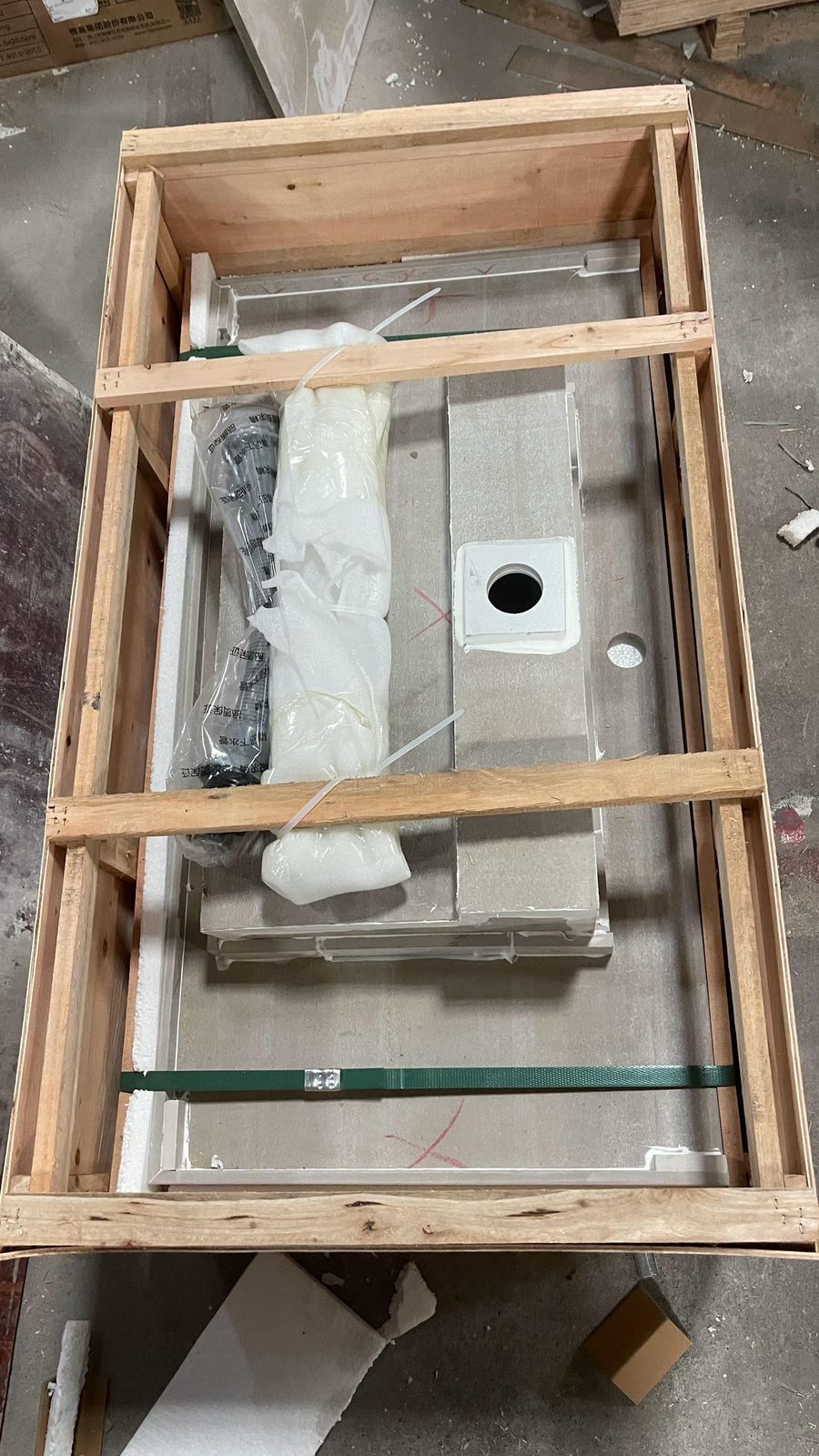
Point 12 — Paperwork and piece count. Count every piece against the packing list and order sheet. Check model numbers and widths on labels against the order. Pass: every piece present, labels matching the order, and the packing list signed against the count. A missing fixing bag stops an installation, so count the small pieces too.
The twelve points at a glance
| # | Check | How | Pass |
|---|---|---|---|
| 1 | Basin dimensions | Tape measure | Matches order sheet |
| 2 | Basin bowl and tap deck | Raking light | No cracks or chips |
| 3 | Tap holes | Count vs tap spec | Matches tap spec |
| 4 | Cabinet square and level | Level, diagonals | Level and square |
| 5 | Cabinet moisture package | Spec + edge check | Matches spec, sealed |
| 6 | Drawer depth and cutout | Open, measure | Clears drain |
| 7 | Slides and hinges | Open/close loaded | Smooth, flush, adjustable |
| 8 | Handles and fixings | Tug, check alignment | Firm and aligned |
| 9 | Mirror light and controls | Switch on, test | Even light, responsive |
| 10 | Finish and colour match | Same-light check | Consistent, smooth |
| 11 | Packing | Crate, foam, framing | Crate sound, no shift |
| 12 | Paperwork and piece count | Count vs list | All pieces present |
Where a pass standard depends on an unconfirmed number, get it in writing before production.
What a checklist cannot catch
A twelve-point inspection catches visible faults. Hidden moisture inside a panel shows no surface sign until the panel swells months later. Long-term durability — how a soft-close damper holds up after years of daily use, how a finish ages under bathroom humidity — cannot be judged in a thirty-minute check; it is judged by the hardware grade and cabinet construction on the order. A hairline crack under a foam pad stays hidden until the foam comes off, which is why the inspection runs after unwrapping.
The checklist also cannot fix a supplier relationship. A supplier that resists written pass standards, refuses pre-shipment photos, or argues about a documented crack has shown you the risk before the money moves.
Confirm the standards in writing before ordering
Confirm five items in writing before ordering: basin dimensions and tap-hole spec, cabinet construction and moisture package, slide and hinge brand and grade, mirror spec including anti-fog, and packing method. Vora’s confirmed order terms: MOQ 10 sets, delivery in 15 working days; sampling needs drawings, material requirements, and packaging requirements. The factory-side routine: Each basin top is checked with a tape measure against the order spec before anything is wrapped. The receiving side: “When your vanity arrives, inspect the crate and the stone before you sign the delivery note.”
For the wider arrival routine, see our guide to what to check when your vanity arrives. For the hardware checks, see our guide to Vanity Hardware That Actually Lasts. For the packing method, see our guide to how bathroom vanities are packed for international shipping.
Browse the cabinets collection or the products page, and use the configurator to set widths and basin layouts.
FAQ
My vanity arrived cracked. Who pays for the replacement? Photograph the damage before the crate is cleared away and notify the supplier the same day, before signing a clean receipt. A signed clean receipt turns a transit claim into an argument about when the crack happened. Confirm claim deadlines and return-freight terms in writing — they vary by order.
The supplier offered a 10% discount for a cracked basin. Should I accept? A cracked basin calls for a replacement. Field repair suits small edge chips, which a fabricator can round and re-polish. Fabricators and buyers treat a crack across a basin as a replacement case, and the stone trade treats accepted repair work as a discount-tier outcome — one fabricator in a long-running r/CounterTops thread put it at “maybe 10%” off.
The supplier says the repair is “95% fixed.” Is that good enough? Buyers on r/askSingapore answered this one plainly: “Demand complete replacement, and ask for video proof.” A basin that is 95% fixed still carries a visible repair and a question about the remaining 5%. For a cracked stone basin, ask for a replacement unit and photo or video proof before it ships.
What should I check if I only have five minutes? Start with the crate, then the stone corners and edges, the tap deck, and the basin bowl. Those four checks catch the damage that is hardest to put right once the unit is installed. If time allows, open and close every drawer and door next — hardware faults are a leading complaint category in aggregated vanity reviews.
How do I check the hardware without installing the vanity? Open and close each drawer empty and loaded, watching the return on the final stretch. Pull each drawer fully out and check side-to-side wobble at the front corners. Work each door and confirm the hinge still has adjustment range in three directions. Smooth travel, a front that lands flush, modest wobble, and adjustment travel in reserve add up to a pass.
Run the twelve checks on your next order
Send your widths, cabinet style, and QC requirements through the inquiry form or WhatsApp.
Replies come from the factory team — Roy handles buyer inquiries. Your inquiry details are used only for this inquiry, and we send no bulk mailing.
Specifications verified against Vora Surfaces factory records. Editorial review applied. Spotted an error? Email corrections to vorasurfaces@gmail.com.
Frequently asked questions
My vanity arrived cracked. Who pays for the replacement?
Photograph the damage before the crate is cleared away and notify the supplier the same day, before signing a clean receipt. A signed clean receipt turns a transit claim into an argument about when the crack happened. Confirm claim deadlines and return-freight terms in writing — they vary by order.
The supplier offered a 10% discount for a cracked basin. Should I accept?
A cracked basin calls for a replacement. Field repair suits small edge chips, which a fabricator can round and re-polish. Fabricators and buyers treat a crack across a basin as a replacement case, and the stone trade treats accepted repair work as a discount-tier outcome — one fabricator in a long-running r/CounterTops thread put it at "maybe 10%" off.
The supplier says the repair is "95% fixed." Is that good enough?
Buyers on r/askSingapore answered this one plainly: "Demand complete replacement, and ask for video proof." A basin that is 95% fixed still carries a visible repair and a question about the remaining 5%. For a cracked stone basin, ask for a replacement unit and photo or video proof before it ships.
What should I check if I only have five minutes?
Start with the crate, then the stone corners and edges, the tap deck, and the basin bowl. Those four checks catch the damage that is hardest to put right once the unit is installed. If time allows, open and close every drawer and door next — hardware faults are a leading complaint category in aggregated vanity reviews.
How do I check the hardware without installing the vanity?
Open and close each drawer empty and loaded, watching the return on the final stretch. Pull each drawer fully out and check side-to-side wobble at the front corners. Work each door and confirm the hinge still has adjustment range in three directions. Smooth travel, a front that lands flush, modest wobble, and adjustment travel in reserve add up to a pass.
Sourcing hot-bent basins for your next project?
Send your drawings and target quantities — we'll confirm feasibility from the factory floor.
Configure your inquirySee the products behind these guides: production cabinet styles and buying terms for buyers & OEM.
Specifications verified against Vora Surfaces factory records. Editorial review applied. Spotted an error? Email corrections to vorasurfaces@gmail.com.